
 listicle
5 Best Ways to Visualize Organic Molecules
Table of Contents
- Why Visualizing Organic Molecules Changes How You Learn Chemistry
- Method 1: Skeletal Formula Organic Chemistry (Bond-Line Notation)
- Method 2: Wedge and Dash Notation for Three-Dimensional Shape
- Method 3: 3D Molecular Models (Physical and Digital)
- Method 4: Organic Chemistry Drawing Tools and Software
- Method 5: Lewis Structures and Structural Formulas
- How to Choose the Right Visualization Method for Your Course
- Conclusion: Building Visual Fluency in Organic Chemistry
- Frequently Asked Questions
Why Visualizing Organic Molecules Changes How You Learn Chemistry
Organic chemistry rewards students who can visualize organic molecules in three dimensions. When you visualize organic molecules, you stop memorizing flat drawings and start predicting how compounds actually behave. That shift is what separates students who survive the course from students who excel in it.
At Chemistry Lessons by Annise, we have watched this transformation in over 1,000 tutored students, and the pattern is consistent: students who build strong visual habits early struggle less with later material. A molecular structure is the arrangement of atoms, the bonds connecting them, and the shape those bonds create in space. Most exam questions test whether you can move between those views.
Below, we break down five methods for representing organic molecules, ranked by how well each builds real understanding.
Method 1: Skeletal Formula Organic Chemistry (Bond-Line Notation)
Skeletal formula organic chemistry is the fastest way to draw complex molecules by hand. Each line endpoint or bend represents a carbon atom, and hydrogen atoms attached to carbon are implied rather than drawn.
This shorthand exists because drawing every atom becomes unmanageable. A simple six-carbon chain looks like a zigzag of five lines. Chemists worldwide read it instantly.
How to Draw a Skeletal Structure Step by Step
- Draw the carbon backbone as connected line segments
- Place a vertex at every endpoint and bend
- Add heteroatoms (oxygen, nitrogen, halogens) with their symbols
- Attach hydrogens only to heteroatoms
- Check that every carbon has four bonds
Reading Molecular Connectivity from Bond-Line Notation
Molecular connectivity is the map of which atoms bond to which. A skeletal structure encodes that map in every line. When you practice converting a full structural formula into bond-line notation, you train your eye to spot connectivity without counting atoms one by one.
Method 2: Wedge and Dash Notation for Three-Dimensional Shape
Wedge and dash notation adds depth to a flat page. A solid wedge means the bond points toward you. A dashed wedge means it points away. Plain lines sit in the plane of the page.
How Wedge-and-Dash Drawings Show Stereochemistry
Stereochemistry is the study of how atoms arrange in three-dimensional space and how that arrangement changes a molecule's properties. Two molecules with identical connectivity can behave completely differently if their spatial arrangement differs.
Wedge-and-dash drawings capture that difference. When you draw a chiral center, the four bonds must show which groups come forward and which recede. Get the wedges wrong and you have drawn a different molecule entirely.
Many students find this the hardest representation to master because it requires imagining a flat drawing as a 3D object. Practice with a physical model beside your paper, then redraw the same molecule from memory.
Method 3: 3D Molecular Models (Physical and Digital)
Nothing builds spatial intuition faster than holding a molecule in your hands. Physical model kits let you rotate bonds, feel steric strain, and see why certain shapes are favored.
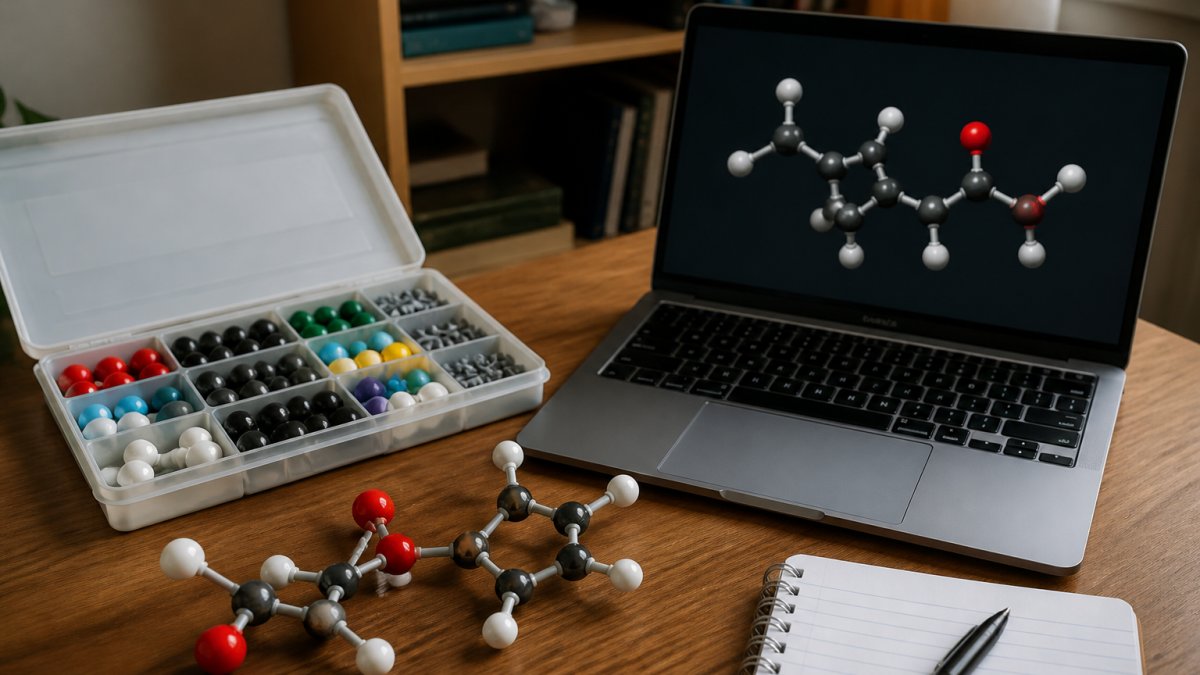
Digital tools like Avogadro's molecular editor, PyMOL, and UCSF ChimeraX offer the same benefit on screen. You can rotate, zoom, and measure angles without buying a kit.
Ball-and-Stick vs. Space-Filling Models
A ball-and-stick model shows atoms as spheres and bonds as connecting rods. It makes bond angles and connectivity easy to see.
A space-filling model shows atoms at their relative sizes with no visible bonds. It shows how much space a molecule actually occupies, which matters when you study how molecules fit together.
Use ball-and-stick to learn geometry. Use space-filling to understand crowding and molecular volume.
Method 4: Organic Chemistry Drawing Tools and Software
Organic chemistry drawing tools let you build structures on a screen and often convert them between representations automatically. This is where software earns its place in your study routine.
Free Options: ChemSketch and Avogadro
ACD/Labs ChemSketch is a free structure drawing program that handles bond-line notation, Lewis structures, and basic 3D views. It is the tool we recommend first to students who want to draw clean structures digitally.
Avogadro focuses on molecular editing and 3D visualization. Together, these two cover most undergraduate needs at no cost.
When to Move to Professional Visualization Software
Research-grade tools like Schrödinger Maestro, MOE, and BIOVIA Discovery Studio handle large molecules, docking, and simulation. They are built for research, not for learning introductory material. Most students never need them.
MarvinSketch from ChemAxon sits in the middle: more capable than freeware, still approachable for coursework.
Method 5: Lewis Structures and Structural Formulas
A Lewis structure shows every atom and every electron involved in bonding, including lone pairs. It is the most complete two-dimensional representation and the foundation for everything else on this list.
Lone pairs are valence electrons not involved in bonding. They influence shape, reactivity, and where a molecule will attack or be attacked.
How to Convert a Lewis Structure to a 3D Representation
Start with VSEPR theory. Electron pairs repel each other, so they spread as far apart as possible. Count bonding pairs and lone pairs around the central atom, then apply the resulting geometry.
| Electron Domains | Geometry | Bond Angle |
|---|---|---|
| 2 | Linear | 180° |
| 3 | Trigonal planar | 120° |
| 4 | Tetrahedral | 109.5° |
| 5 | Trigonal bipyramidal | 90° / 120° |
| 6 | Octahedral | 90° |
Once you know the geometry, you can draw the wedge-and-dash version or build the model. That chain, from Lewis structure to VSEPR to 3D, is the core skill this whole topic builds toward.
How to Choose the Right Visualization Method for Your Course
Match the method to what you are trying to learn, not to what looks most impressive.
- Learning connectivity: skeletal formula and structural formulas
- Learning stereochemistry: wedge-and-dash drawings, then physical models
- Learning shape and angles: 3D models and VSEPR
- Checking your work: drawing software
- Exam preparation: hand drawing, every time
For most students, the winning combination is hand drawing plus one physical model kit. Add software only when a specific problem calls for it.
Conclusion: Building Visual Fluency in Organic Chemistry
Visual fluency does not arrive overnight. It comes from repeated practice moving between representations until the translation feels automatic. Students who put in that work find that later topics, from reaction mechanisms to stereochemical outcomes, suddenly make sense.
The five methods covered, skeletal formulas, wedge-and-dash, 3D models, drawing software, and Lewis structures, each serve a purpose. Use them together to build a complete understanding of organic molecules.
That is exactly the work we do at Chemistry Lessons by Annise. Our founder brings more than 30 years of experience as a former university professor and organic chemistry research scientist, and every session is tailored to the specific course a student is taking. Nearly 290 five-star reviews reflect what families tell us repeatedly: patient explanations, real grade improvement, and confidence that lasts.
Request a lesson with Chemistry Lessons by Annise and start turning molecular confusion into genuine understanding.
Frequently Asked Questions
What is the difference between a structural formula and a molecular model?
A structural formula shows which atoms connect to which using lines for bonds, all on a flat page. A molecular model adds the third dimension: bond angles, the shape around each atom, and how groups sit in space. Structural formulas are faster to draw and read; models reveal properties like polarity and how a molecule fits into a binding site. Most students need both, starting with the formula and building the model when shape matters.
How do wedge-and-dash drawings show three-dimensional structure?
Wedge and dash notation uses three line types: a solid wedge points toward you, a dashed wedge points away, and a plain line sits in the plane of the page. Placed on a stereocenter, these marks tell you whether a substituent is above or below the page. That is enough to assign R/S configuration and to spot whether two drawings show the same molecule or a mirror image.
What tools can you use to visualize molecules in 3D?
For drawing, ChemSketch and MarvinSketch let you build structures and generate 3D views. For viewing and rotating, Avogadro, PyMOL, UCSF ChimeraX, VMD, Schrödinger Maestro, MOE, and BIOVIA Discovery Studio are all options named in molecular visualization roundups. Start with a free drawing tool if you are new to 3D molecular models. If you need help interpreting what you see, a tutor can walk you through the geometry.
How do molecular models help with stereochemistry?
Stereochemistry is about how atoms arrange in space, and a model lets you rotate the whole structure. You can see whether two substituents are on the same side or opposite sides, check if a molecule is chiral, and compare conformations by twisting single bonds. Physical ball-and-stick kits and digital 3D viewers both work. Building the model yourself forces you to track each bond, which is where the learning happens.
What is the best way to visualize organic molecules for exam prep?
Match the method to what the exam asks. If you need to draw products, practice skeletal formulas until they are automatic. If you need to assign stereochemistry, drill wedge and dash notation on stereocenters. If you need to predict shape or polarity, build or view a 3D model. Most AP, Honors, and college exams test all three, so rotate through methods rather than sticking to one.