 how-to
Overcoming Test Anxiety in Chemistry: 7 Steps
Table of Contents
- What Test Anxiety in Chemistry Looks Like
- How to Study for Chemistry Exams So Confidence Replaces Fear
- Relaxation Techniques for Test Anxiety That Work in Real Time
- How to Calm Down Before an Exam: The Final 24 Hours
- Chemistry Test-Taking Strategies for the Exam Room
- Support, Accommodations, and When Tutoring Helps
- Conclusion: Building Confidence Step by Step
- Frequently Asked Questions
Last Updated: October 12, 2026
What Test Anxiety in Chemistry Looks Like
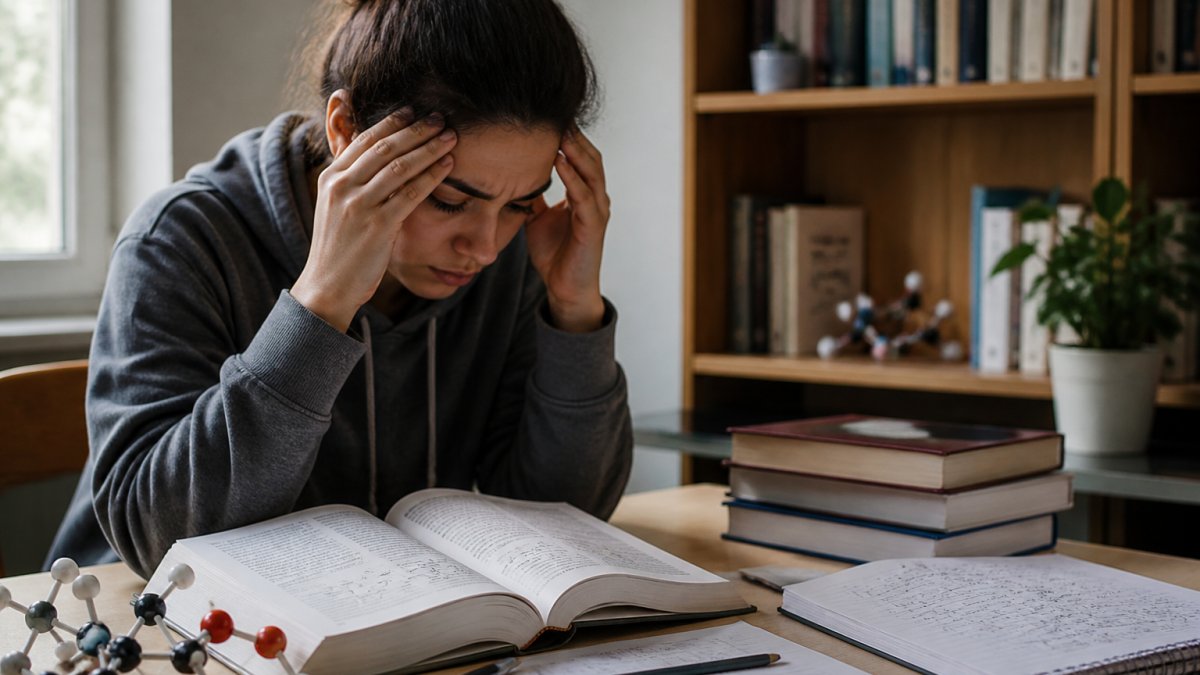
Test anxiety in chemistry is a physical and mental stress response that hits before or during an exam, making it hard to recall material you know.
Then the mind joins in. You blank on a formula you practiced a dozen times. You reread the same question three times without understanding it.
At Chemistry Lessons by Annise, we have worked with over 1,000 students, and the pattern is consistent: the students who struggle most on test day are often not the ones who know the least, but the ones whose nerves drown out what they know.
That distinction matters, because overcoming test anxiety in chemistry starts with knowing which problem you actually have.
Physical, Mental, and Behavioral Signs
Anxiety does not look the same for everyone. Watch for these signs:
- Physical: headaches, nausea, rapid heartbeat, shallow breathing, tense shoulders
- Mental: blanking on formulas, racing thoughts, trouble focusing, comparing yourself to others
- Behavioral: procrastinating on studying, skipping review sessions, rushing through the exam to escape it
One student might feel calm but freeze mid-problem. Another might feel physically ill the night before. Both are dealing with the same stress response.
Anxiety or a Chemistry Knowledge Gap?
This is the question most guides skip, and it changes everything about how you prepare.
Anxiety is a stress response. A knowledge gap is missing content. They can look identical on a test, but they need different fixes.
Ask yourself:
- Can you solve the problem at home, unhurried, with notes nearby?
- Do you blank only when the clock is running?
- Does the material make sense in class but vanish on the exam?
If you can do the work calmly but not under pressure, that points to anxiety. If you cannot do it even with unlimited time and notes open, you are looking at a knowledge gap.
How to Study for Chemistry Exams So Confidence Replaces Fear
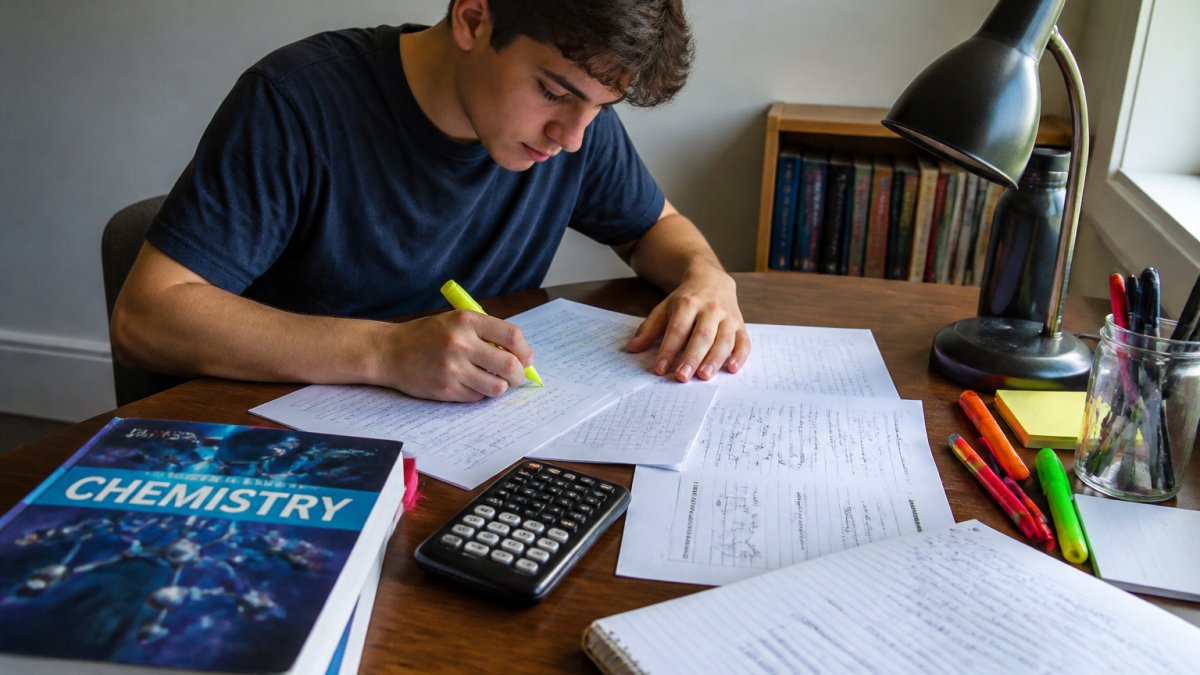
Confidence in chemistry comes from repetition under realistic conditions, not from rereading notes. Highlighting feels productive but does not build recall, and chemistry exams ask you to pull formulas, mechanisms, and problem-solving steps from memory, fast. Practice should look like the exam, not the textbook.
A Weekly Plan Built Around Practice Questions
Here is a simple weekly structure we recommend to students preparing for AP, Honors, Regents, or General Chemistry exams:
- Monday: Review one topic, then answer 10 practice questions without notes.
- Tuesday: Redo the questions you missed and write out why you missed them.
- Wednesday: Move to a new topic, then mix in 5 questions from Monday's topic.
- Thursday: Timed practice set, 20 questions in 30 minutes.
- Friday: Review every error from the week and rework each one.
- Weekend: One full practice exam under real conditions.
The mixing matters: real exams jump between topics, so your practice should too. This is how to study for chemistry exams in a way that trains your brain for the actual test.
Relaxation Techniques for Test Anxiety That Work in Real Time
The fastest way to calm your body during an exam is slow, deep breathing. A longer exhale activates the parasympathetic nervous system, slowing heart rate and signaling your body to stand down. That is a physiological lever, not a mindset trick, which is why breathing beats willpower when your hands shake over a stoichiometry problem.
Try this pattern, which you can use at your desk without anyone noticing:
- Breathe in through your nose for a count of four.
- Hold for a count of four.
- Breathe out through your mouth for a count of six.
- Repeat four times.
The longer exhale is the key. It is one of the most reliable relaxation techniques for test anxiety because it works in under a minute.
Other techniques that help:
- Grounding: Press your feet into the floor and name five things you can see.
- Progressive muscle relaxation: Tense and release your shoulders, jaw, and hands.
- Mindfulness: Notice the anxious thought, label it "just a thought," and return to the question.
Pairing Calm With Chemistry Cues
Generic calming advice only goes so far. The trick is attaching a relaxation cue to a chemistry action you already take, so calm arrives on demand instead of after five minutes of fighting your own pulse.
A few pairings that work:
- Before you read a word problem: one slow exhale, then underline the knowns and the unknown. The exhale becomes the trigger for the reading habit.
- Before you write a formula: one slow exhale, then write the formula and its units. You are training your body to associate formula-writing with steadiness.
- When you flip to a new page: one slow exhale, then scan for the easiest problem. The page turn becomes the cue, not the panic.
After a week of practice, the cue alone starts to lower your heart rate, the same principle behind athletes' pre-shot routines.
Writing About Anxiety Before the Exam
One technique that surprises students: spend ten minutes writing about your worries right before the test. Research on expressive writing suggests getting anxious thoughts onto paper frees up working memory for the exam itself. You are not solving your worries, just emptying them so they stop looping. Try it the night before and again in the ten minutes before the exam, then close the notebook and move on.
How to Calm Down Before an Exam: The Final 24 Hours
The final day is not for cramming new material. It is for locking in what you already know and getting your body ready to perform.
Here is a step-by-step plan for the last 24 hours before a chemistry exam:
- Morning: Review your formula sheet and one-page summary. No new topics.
- Afternoon: Do one short, timed practice set. Stop while you still feel sharp.
- Evening: Eat a normal meal, pack your materials, and stop studying by early evening.
- Night: Go to bed at your usual time. Sleep is when your brain consolidates what you studied.
- Morning of: Eat a healthy breakfast, arrive early, and do one round of deep breathing before you enter the room.
Avoid studying until the last second; students who do often walk in exhausted, and exhaustion makes anxiety worse.
Chemistry Test-Taking Strategies for the Exam Room
Good chemistry test-taking strategies keep you moving and stop small stumbles from snowballing into panic. Start with a two-minute scan of the whole exam: note the point values, mark the questions you know you can do, then work the easy ones first to build momentum and bank points before the hard sections.
Other strategies that help:
- Read each question twice and underline what it is asking.
- Write down formulas, units, and given values before you solve.
- Show your work, even when you are unsure. Partial credit adds up.
If your mind goes blank, do not fight it. Skip the question, answer something you know, and come back. The blank usually clears once you stop staring at it.
A Step-by-Step Routine for Getting Unstuck on Chemistry Problems
Getting stuck is normal. The mistake is staying stuck. Here is a short routine for when a chemistry problem stalls you:
- Reread the question and identify exactly what it is asking for. Is it asking for moles, mass, concentration, or something else? Write the target quantity and its unit at the top of your scratch space.
- List the knowns with units. Every given value, every constant on the formula sheet, and the units attached to each. Unit labels are not decoration; they tell you which conversion factors you need.
- Choose a formula that connects knowns to the unknown. If more than one formula fits, pick the one whose units cancel toward your target. If the units do not cancel, you have the wrong formula.
- Work backward from the target if forward is unclear. Ask what the last step must produce, then what feeds into it, then what feeds into that. This turns a wall into a staircase.
- If you are still stuck after about a minute, mark it and move on. Come back after you have banked a few easier points. Fresh eyes find the missing link far more often than stubborn ones.
- When you return, restart from the last step you were sure of. Do not redo the whole problem. Pick up where your confidence ended.
Most students who get stuck are missing one small link, not the whole concept, a unit mismatch, a forgotten mole ratio, a sign error in an enthalpy problem. The routine above surfaces that link instead of letting you spiral.
Chemistry-Specific Traps to Watch For
A few patterns trip up even strong students under time pressure:
- Mixing up molarity and molality. Molarity is moles per liter of solution; molality is moles per kilogram of solvent. The exam will not remind you.
- Forgetting to balance before using mole ratios. An unbalanced equation gives you the wrong ratio, and every downstream step inherits the error.
- Using the wrong gas constant. Match R to the units in the problem (L·atm vs. J vs. kPa·L). The formula sheet usually lists several.
Budgeting Time Without a Clock in Sight
If the room has no visible clock, set a mental checkpoint at the halfway mark. When you reach it, count how many problems remain and how many points they carry. If you are behind, skip the highest-effort, lowest-point items and return only if time allows. Points per minute is the only math that matters in the final stretch.
Support, Accommodations, and When Tutoring Helps
Sometimes anxiety is bigger than a study plan can fix, and that is not a failure.
This is where Chemistry Lessons by Annise fits.
One parent put it simply: "Annise has done a fantastic job helping my daughter understand chemistry and her grades have continued to improve."
If your student understands the concepts but blanks on test day, that is exactly the kind of problem we work on.
| Problem | What It Looks Like | Best Fix |
|---|---|---|
| Knowledge gap | Cannot solve even with notes and time | Content tutoring and practice |
| Test anxiety | Knows the material, blanks under pressure | Relaxation and exam strategies |
| Both | Inconsistent scores, freezes on hard items | Tutoring plus anxiety techniques |
| Time pressure | Runs out of time, rushes, makes errors | Timed practice sets |
Conclusion: Building Confidence Step by Step
Overcoming test anxiety in chemistry is not about willing yourself to relax. It is about building real skill, practicing under pressure, and calming your body when the nerves hit.
Start with the study plan. Add the breathing and writing techniques. Use the exam-room strategies when you get stuck. And if the gap between what you know and what you score keeps growing, get support.
Frequently Asked Questions
What is test anxiety, and why does it hit so hard in chemistry?
Test anxiety is the physical and mental stress response that shows up before or during an exam: racing heart, blanking on material you know, and negative self-talk. Chemistry can trigger it more than other subjects because problems are multi-step, so one uncertain step can feel like total failure. The fix is twofold: build familiarity through regular practice questions, and use relaxation techniques for test anxiety so your body stays calm enough to let what you know come through.
How do I relax the night before a chemistry exam?
Treat the final evening as review, not cramming. Do a short pass through your summary sheet, then stop. Eat a normal dinner, skip extra caffeine, and go to bed at your usual time. If your mind races, write down your worries on paper for a few minutes, a technique that helps clear anxious thoughts before sleep. Sleep is the single most useful study tool you have, because it helps your brain consolidate formulas and problem patterns.
What should I do if I panic during a chemistry test?
Stop writing and put your pencil down for thirty seconds. Breathe slowly, in through your nose and out through your mouth, until your heart rate settles. Then read the problem again from the top and write down what you are given and what is asked. If you are still stuck, move to an easier question and come back later. Panic narrows your focus, so deliberately widening your attention to the whole page is often enough to get moving again.
Can tutoring really help with test anxiety, or is it just content review?
The two are connected. A tutor who has taught at the university level for decades can spot whether your anxiety comes from shaky content or from test-day nerves, and that changes what you practice. When you walk into an exam knowing you have solved similar problems under time pressure, the fear of failure loses much of its grip. If blanking on test day is your pattern, look for instruction that builds both chemistry mastery and test-taking skills together.
Chemistry exams reward preparation and punish panic. If your student knows the material but freezes on test day, that gap is fixable. Chemistry Lessons by Annise offers personalized, expert-led tutoring from a former university professor with over 30 years of experience, tailored to AP, Honors, Regents, and General Chemistry courses, online or in person on Long Island. Request a lesson and turn confusion into confidence.