 how-to
How to Improve AP Chemistry Grades: 7 Proven Steps
Table of Contents
- Why AP Chemistry Grades Drop and How to Turn Them Around
- Step 1: Build a Weekly Study Schedule That Sticks
- Step 2: Master Concepts With Active Recall and Spaced Repetition
- Step 3: Use AP Chemistry Free Response Practice to Expose Weak Spots
- Step 4: Score Yourself With Official Scoring Guidelines
- Step 5: AP Chemistry Study Tips for Exam Day
- Step 6: Choose the Best AP Chemistry Prep Resources
- Step 7: Protect Your Focus and Avoid Burnout
- Frequently Asked Questions
Last Updated: October 4, 2026
Why AP Chemistry Grades Drop and How to Turn Them Around
Most students do not fail AP Chemistry because the subject is too hard. They fail because of how they study. According to the College Board's AP Chemistry course description, the exam tests your ability to apply concepts to new situations. At Chemistry Lessons by Annise, we have tutored over 1,000 students and seen the same pattern every time.
The 7 steps below give you a clear path from confusion to confidence.
Step 1: Build a Weekly Study Schedule That Sticks
A consistent study schedule beats cramming. Block out 4 to 5 short sessions per week instead of one long marathon; short sessions keep your memory sharp and fit around your other classes.
How Many Hours Per Week Do You Actually Need?
Most AP Chemistry students need 5 to 7 hours of study per week outside class, split into 45-minute blocks with short breaks. A workable weekly plan looks like this:
- Monday: Review class notes and rework examples (45 minutes)
- Tuesday: Practice stoichiometry and chemical equations (45 minutes)
- Wednesday: Active recall session with flashcards (30 minutes)
Track your weak topics each week, then aim your next session at them first.
Step 2: Master Concepts With Active Recall and Spaced Repetition
Active recall means testing yourself instead of rereading; spaced repetition means reviewing at growing intervals. Together they build long-term memory, unlike highlighting, which feels productive but does little.
Note-Taking That Works for Stoichiometry and Thermodynamics
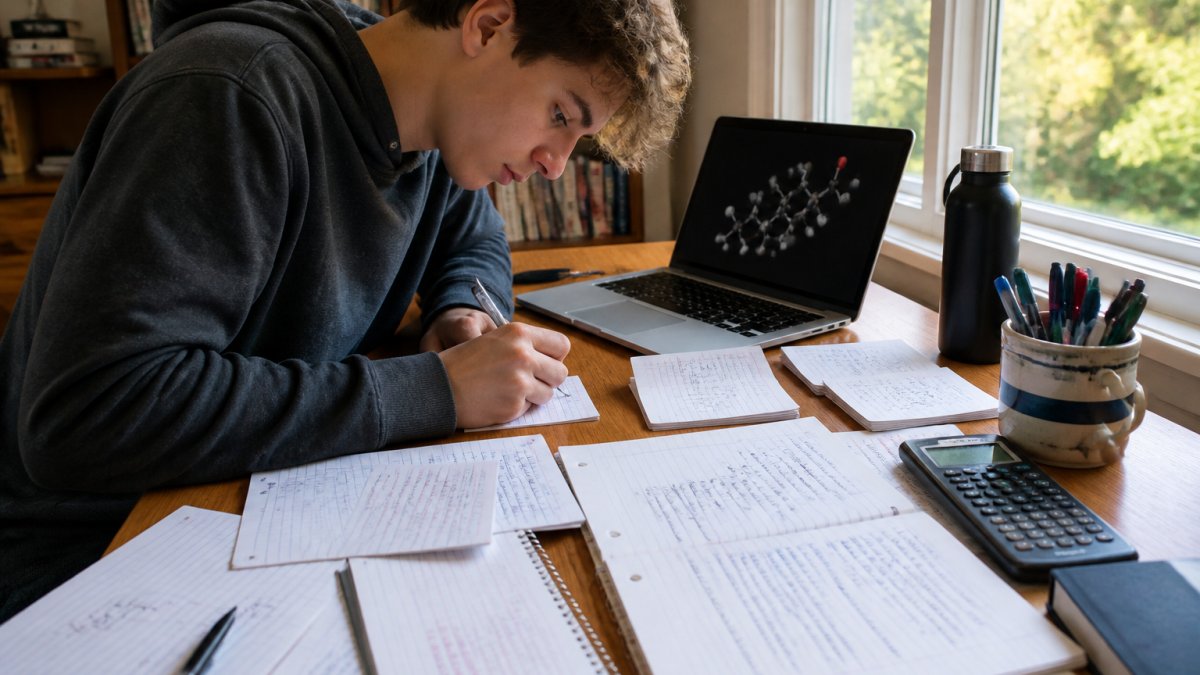
Build one-page summary sheets for each big topic.
- Stoichiometry: mole ratios, limiting reactants, percent yield
- Thermodynamics: enthalpy, entropy, Gibbs free energy
- Molecular structure: VSEPR shapes, bond angles, polarity
Quiz yourself from these sheets daily: cover the answers and say them out loud.
Step 3: Use AP Chemistry Free Response Practice to Expose Weak Spots
AP Chemistry free response practice finds your gaps fastest, but only if you run it like a diagnostic: score yourself against the same rubric graders use. Most students skip that step, the single biggest wasted hour in AP Chemistry prep.
The Scoring-Driven Free Response Workflow
Run every practice set through the same five-step loop.
- Pull the question and the official scoring guidelines together. The AP Chemistry free response questions and scoring guidelines archive publishes both, the actual point-by-point rubric graders apply. Never practice without the guidelines open.
- Time yourself to the real clock. The free response section gives you roughly 105 minutes for 7 questions, about 15 minutes each. Short-answer questions move faster, long-answer questions eat more. Practice under that clock so exam day feels familiar.
- Write your answer in full sentences with units and significant figures. Graders award points for specific claims and labeled work: a correct number with no setup often earns zero, a wrong number with correct setup often earns partial credit.
- Score yourself point by point using only the guidelines. Do not credit yourself for what you meant. If the guideline says 'correctly identifies the limiting reactant and supports with mole ratio,' you need both halves. Circle every missed point and note the exact guideline language.
- Log the miss by category, not by question. Tag each lost point as one of: concept gap (did not know the chemistry), setup gap (knew the chemistry but set it up wrong), communication gap (knew it and set it up right but did not write what the grader needed), or time gap (ran out of clock).
Why the Category Log Beats a Mistake Log
A plain mistake log tells you what you got wrong. A category log tells you why, and the fix differs by category.
- Concept gaps need content review. Go back to your summary sheet for that topic and rebuild it.
- Setup gaps need repetition on problem types. Do five more of the same structure before moving on.
- Communication gaps need rubric practice. Rewrite the same answer three times, each time matching the guideline language more closely.
Most students assume every miss is a concept gap and reread the textbook, but communication and setup gaps usually outnumber concept gaps on the free response section. Fixing the right category beats another hour of reading.
Free Response Question Types to Rotate Through
The free response section mixes long-answer and short-answer questions across the full course. Rotate through all of these so no type surprises you:
- Stoichiometry and solution chemistry with limiting reactants and percent yield
- Thermodynamics with enthalpy, entropy, and Gibbs free energy calculations
- Equilibrium including acid-base, solubility, and Le Chatelier reasoning
Do at least one question from each type before you repeat a type. Breadth first, then depth on your weakest categories.
Step 4: Score Yourself With Official Scoring Guidelines
The scoring guidelines show exactly how graders award points, each point maps to a specific claim, equation, or explanation. After every practice set, read the question and your answer side by side, award points using the official guidelines only, circle every missed point, and write the correct reasoning in your own words. This kills the "I knew that" trap: if you did not write it, you did not earn it.
Step 5: AP Chemistry Study Tips for Exam Day
Exam day rewards calm, prepared students. These AP Chemistry study tips keep your head clear.
- Sleep at least 7 hours the night before
- Eat a real breakfast
- Bring extra pencils, a calculator, and a watch
Time Management on Multiple Choice and Long-Answer Questions
The multiple choice section gives you about 90 seconds per question: move fast, flag hard ones, and come back. For long-answer questions, read all parts first, then budget time by point value. Never leave a part blank; partial credit adds up.
Step 6: Choose the Best AP Chemistry Prep Resources
The best AP Chemistry prep resources combine official materials with expert help: start with the College Board's practice exams and scoring guidelines, add one review book for content coverage, then find a tutor who can explain the topics your book cannot.
No book adapts to you; a tutor does. At Chemistry Lessons by Annise, our founder brings more than 30 years of experience as a former university professor and organic chemistry research scientist.
Step 7: Protect Your Focus and Avoid Burnout
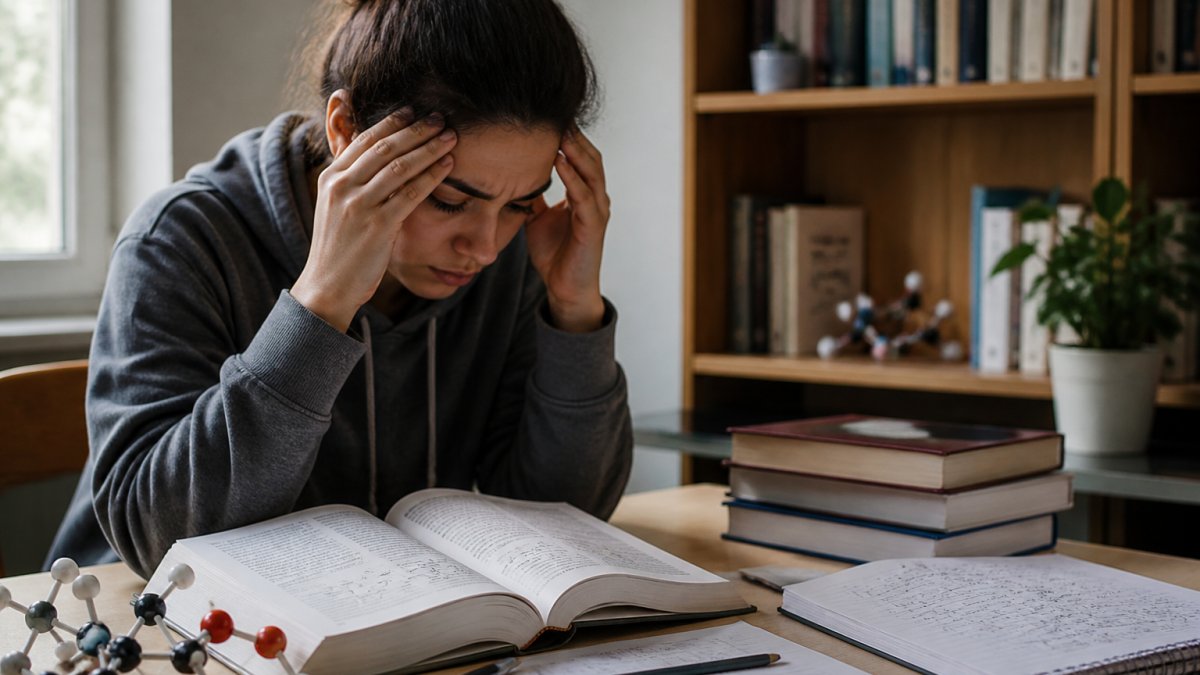
Burnout destroys grades faster than any hard topic, and AP Chemistry is unusually good at causing it. Watch for dreading every study session, poor sleep, falling scores despite more hours, and unfinished lab reports piling up. When they show up, cut back instead of pushing harder: more hours on a burned-out brain produces worse results than rest.
A Lab Report Workflow That Protects Your Grade and Your Time
AP Chemistry grades are heavily influenced by labs, and strong lab reports lift both your course grade and your exam readiness. Most students write them the night before they are due, rush the analysis, and lose points on the exact skills the free response section tests. Run labs through a structured workflow instead.
Write the report in three passes, not one sitting.
- Pass one, during lab. Record raw data in a bound notebook with units, significant figures, and conditions as you go. Do not rely on memory; if a reading looks off, note it and why.
- Pass two, within 24 hours. Write the purpose, procedure summary, and data table while the experiment is fresh. This takes 20 to 30 minutes.
- Pass three, before the due date. Write the analysis, error discussion, and conclusion, this is where the points live.
Where Lab Report Points Actually Come From
Graders award points for specific things. Hit these every time:
- Clear purpose tied to a concept. State what principle the lab demonstrates, not just what you did.
- Procedure in your own words. Copied procedures earn no credit and often signal you did not understand the method.
- Data with units and significant figures. A number without units is a lost point. Significant figures must match the precision of your instruments.
Digital Tools That Cut Lab and Study Time
You do not need a paid app, but a few free tools help: a note app with linked pages for your summary sheets and error bank, a flashcard app with spaced repetition, and a spreadsheet for tallying misses by type. The tool matters less than the habit of keeping everything in one searchable place.
Protect Your Focus With Simple Habits
- Study in 45-minute blocks with 10-minute breaks
- Keep your phone in another room during study blocks
- Move your body daily, even for 20 minutes
Frequently Asked Questions
What is the best way to study for AP Chemistry?
The most effective approach combines active recall, spaced repetition, and practice exams. Quiz yourself on concepts like thermodynamics and molecular structure instead of rereading notes, then revisit them on a schedule. Work through free response questions under timed conditions and score them with official guidelines. This cycle of practice and feedback beats cramming before the exam.
How do I prepare for AP Chemistry free response questions?
Start by reviewing the question types: short-answer, long-answer, and experimental design. Practice writing full responses with chemical equations, units, and clear reasoning, then compare each attempt to the scoring guidelines and note where you lost points. Doing two to three free response questions per week builds the skills and stamina the exam demands.
Is it possible to improve my AP Chemistry grade in one semester?
Yes, with consistent effort. A semester gives you roughly 15 weeks: study four to five hours per week, target your weakest topics first, and use practice exams to track progress. The key is identifying gaps early and adjusting your study plan. Many students see meaningful improvement within six to eight weeks.
How much time should I spend studying for AP Chemistry each week?
Plan for four to six hours per week outside class, spread across three or four sessions, including content review, practice problems, and free response work. As the exam approaches, increase to six to eight hours. Quality matters more than quantity: a focused 45-minute session with active recall beats two hours of passive rereading.
Improving your AP Chemistry grade is a challenge, but it is one you can win with the right system. If you want faster progress, Chemistry Lessons by Annise offers personalized instruction tailored to your course, whether you need help with stoichiometry, thermodynamics, or exam-day nerves. Get started and turn confusion into confidence.