 Ultimate guide
The AP Chemistry Materials That Actually Raise Scores
Last Updated: November 14, 2026
Quick Summary
AP Chemistry materials are resources built to cover the College Board's course content and exam format, including unit-aligned notes, worked problems, practice questions, past free-response prompts, and reference sheets. Useful materials pass three tests: they align to a named unit, include problems with worked solutions, and force recall rather than passive reading.
- The AP Chemistry course organizes content into nine units, from atomic structure through electrochemistry.
- Past papers are the highest-value materials, but treat them as diagnostics rather than practice tests.
- Read the free-response scoring guideline first, since it awards points for setup and reasoning, not just final answers.
- Take one timed multiple-choice section and one free-response set to establish a baseline before scheduling anything.
- Copy the equation sheet by hand once, grouping equations by unit, to learn what is provided.
Table of Contents
- What Counts as AP Chemistry Material and What Doesn't
- AP Chemistry Units: Matching Materials to Each Unit
- AP Chemistry Unit 1 Materials for Atomic Structure and Properties
- Choosing an AP Chemistry Study Guide PDF Without Wasting Money
- How to Use AP Chemistry Past Papers for Real Gains
- Building a Study Plan Around Your Material and Your Timeline
- Request a Lesson and Get Your Materials Organized
- Frequently Asked Questions
What Counts as AP Chemistry Material and What Doesn't
AP Chemistry materials are any resources built to cover the College Board's course content and exam format: unit-aligned notes, worked problems, practice questions, past free-response prompts, and reference sheets. Students often bury themselves in folders of material that never touches the exam's actual demands. A thick textbook chapter is not automatically material worth your time.
The distinction matters because the AP Chemistry course organizes content into nine units, from atomic structure through acids and bases to electrochemistry, and the exam tests that content through both multiple-choice and free-response sections. Anything that doesn't map to those units or that question format is background reading, not preparation. Start with the official AP Chemistry course description so you know exactly what the exam covers before you buy or download anything.
What separates useful AP Chemistry material from filler comes down to three tests: it aligns to a named unit, it includes problems with worked solutions, and it forces recall rather than passive reading. A resource that fails two of the three is a distraction. Below, we'll show you how to inventory what you have, match it to each unit, and build a plan around your timeline.
AP Chemistry Units: Matching Materials to Each Unit
The nine AP Chemistry units each demand a different kind of resource, and using the wrong format for a unit wastes weeks. Atomic structure and properties rewards flashcards and quick recall drills. Compound structure and bonding, including chemical bonding and intermolecular forces, rewards drawing practice and Lewis structure repetition.
Here's the practical split we recommend:
| Unit focus | Best material format | Why it works |
|---|---|---|
| Atomic structure and properties | Flashcards, timed recall questions | Definitions and trends reward repetition |
| Compound structure and bonding | Blank-page drawing practice, guided notes | You must draw structures from scratch |
| Stoichiometry and reactions | Worked problems with full solutions | Setup errors show up only in practice |
| Kinetics and thermodynamics | Problem sets plus equation sheet drills | Math and sign conventions need reps |
| Equilibrium, acids and bases | Past free-response questions | Multi-step reasoning mirrors the exam |
| Electrochemistry | Mixed problem sets and summaries | Combines several earlier units |
A unit-by-unit cheat sheet helps you decide what to study when. Our AP Chemistry Master Cheat Sheet: What to Study and How breaks each unit into the concepts and equations that matter most, which makes it easier to match a resource to a gap.
AP Chemistry Unit 1 Materials for Atomic Structure and Properties
Unit 1 material should do one job: make atomic properties automatic. The unit covers atomic structure, electron configuration, periodic trends, and mass spectrometry, and it rewards short, frequent recall over long reading sessions. A common mistake is treating Unit 1 as "easy" and skipping it, then losing points on trend questions later in the year.
Build your Unit 1 stack from three pieces. First, a one-page summary of periodic trends with the reasoning behind each trend, not just the direction. Second, flashcards for electron configuration exceptions and common ion charges. Third, a set of practice questions that ask you to justify a trend, since the exam rarely asks you to state one without explanation.
What most guides miss is that Unit 1 concepts resurface in every later unit. Intermolecular forces depend on atomic properties. Electrochemistry depends on electron behavior. Spending two focused weeks on Unit 1 material early pays off across the whole course.
Choosing an AP Chemistry Study Guide PDF Without Wasting Money
A study guide PDF earns its place only if it does three things: covers units you're actually weak in, includes practice with answer explanations, and matches the current exam format. Most PDFs fail on the second point. They list facts and skip the reasoning, which means you can read a chapter and still miss the question on test day.
Before you commit to any guide, run this checklist:
- Does it label content by AP unit number?
- Are there worked problems with full solutions, not just answers?
- Does it include free-response style questions with scoring guidance?
- Is it current enough to reflect the exam's equation sheet and format?
- Does it fit your weakest units rather than repeating what you know?
If a guide fails two or more boxes, skip it. If you're weighing a guide against a full textbook, our alternatives to standard AP Chemistry textbooks covers options that cost less and target the exam more directly.
Watch out: downloading five free PDFs and reading none of them is the most common waste of money and time we see. One guide used thoroughly beats five skimmed once.
How to Use AP Chemistry Past Papers for Real Gains
Past papers are the highest-value AP Chemistry materials you can use, but only if you treat them as diagnostics rather than practice tests. The College Board releases free-response questions from prior years, and those prompts show you exactly how the exam phrases multi-step problems and how points are awarded. Released scoring guidelines are often skipped, yet they show where points are awarded.
Read the scoring guideline before you answer
A free-response scoring guideline is not an answer key. It is a point-by-point list of what earns credit, and it often awards points for setup and reasoning rather than for the final number.
Before working a prompt, read its guideline and label each point as content, setup, or explanation. That label tells you what the graders reward, and it exposes where your own answers tend to fall short.
Work the prompts in three passes
First, work a full free-response set untimed and score it against the official guideline, marking every point you missed and why. Second, rework only the missed parts a week later without looking at your notes. Third, group your errors by unit and topic so you can see whether the problem is content, setup, or arithmetic. Errors often cluster in a few units, which can point to where to focus next.
The scoring losses that repeat
A few mistakes show up again and again in scored responses. Watch out: unsupported answers, a number with no setup or no units, routinely lose points even when the value is correct. Significant figures are scored in specific parts of some prompts, so a correct calculation reported to the wrong precision can still drop a point. Explanations that restate the question instead of naming the principle earn nothing; the guideline wants the reason, not the observation.
Pair free-response work with multiple-choice practice
For multiple-choice practice, pair past free-response work with a vetted question bank. Our list of the best AP Chemistry practice tests covers which sources actually mirror the exam's difficulty. Keep a running tally of missed multiple-choice topics next to your free-response error log so the two views agree on which units need work.
Building a Study Plan Around Your Material and Your Timeline
The right plan depends on how many weeks you have and where you're starting, not on a generic calendar. A student with eight weeks and gaps across several units needs to rebuild content first, then practice. The difference between the two is a diagnostic, and most students skip it.
Start with a baseline, not a calendar
Before you schedule anything, take one timed multiple-choice section and one free-response set under exam conditions. Score both honestly. The result is your baseline, and it tells you which units are already solid and which need rebuilding. Without it, a study plan is guesswork dressed up as discipline.
Week-by-week structures for three timelines
Match your material to the time you have:
- Twelve or more weeks: one week per unit for content, using unit-aligned notes and worked problems, then four weeks of past-paper work and error review. Reserve the final week for full timed sections under exam conditions.
- Six to eight weeks: two units per week with daily problem sets, front-loading the units your baseline flagged as weakest, then two weeks of timed practice and free-response scoring.
- Under four weeks: skip broad review. Diagnose your two weakest units with a practice set, rebuild those, and spend the rest on free-response strategy and equation-sheet drills.
Use the equation sheet and calculator as study tools
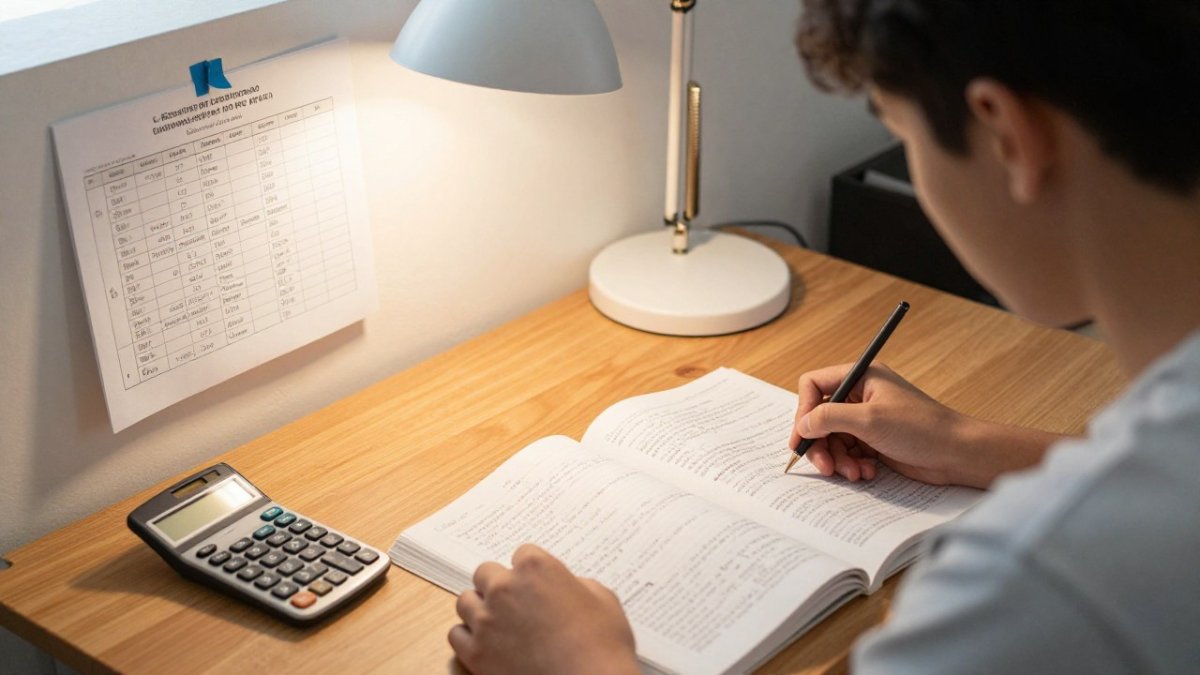
The exam supplies an equation sheet and permits a calculator, and both reward familiarity. Copy the equation sheet by hand once, grouping equations by unit, so you know what is provided and what you must recall. Then practice locating the right equation under time pressure rather than deriving it from scratch. For the calculator, rehearse the operations you actually need, scientific notation, logarithms for pH and equilibrium, and reciprocal functions, so keystrokes do not eat minutes on test day.
Track progress at the topic level
Track progress with a simple log: date, unit, resource used, questions missed, and the reason for each miss. Review the log weekly and let it set the next week's priorities rather than following a fixed calendar. For a fuller structure, our step-by-step AP Chemistry study plan walks through how to sequence material week by week.
Request a Lesson and Get Your Materials Organized
Material alone doesn't fix a score if the gaps are conceptual or the test-day execution falls apart. That's where personalized instruction changes the outcome.
Students who have worked with Annise often point to how thoroughly concepts get explained. "Annise was very knowledgeable about organic chemistry.
If you're deciding between structured help and going it alone, our comparison of online tutoring versus self study lays out the trade-offs honestly.
If your materials are organized but the scores still aren't moving, the missing piece is usually targeted instruction rather than another PDF.
Frequently Asked Questions
What materials do I need to study for AP Chemistry?
You need four things: a unit-by-unit review source, guided notes you write yourself, a question bank with worked solutions, and released free-response questions. The College Board's AP Central course page lists the official course units and equation sheet, which anchor everything else. Add a graphing calculator and a formula reference you can use without flipping pages. Most students overbuy books and underuse practice questions, so weight your budget toward practice sets rather than another summary guide.
Where can I find free AP Chemistry study materials?
AP Central publishes the course description, equation sheet, and released free-response questions at no cost. Many school districts and public libraries also provide free access to review platforms and test-prep databases with a library card. Free materials work well for practice questions and equation-sheet familiarity, but they rarely give you a sequenced plan or feedback on written answers. Pair free practice with a structured review source so you are not guessing which unit to tackle next.
How should I use AP Chemistry notes and practice questions together?
Write notes by unit, then close them and answer five practice questions on that unit immediately. Anything you miss goes back into the notes as a correction, not a new page. Repeat the cycle weekly so old units resurface instead of disappearing after the test. Practice questions without note review turn into guessing, and notes without practice turn into recognition rather than recall. The pairing is what moves scores, especially on free-response items where you must show work.
Is 70% a 5 on the AP Chemistry exam?
No single percentage maps cleanly to a 5 because the College Board sets score cutoffs each year after reviewing exam data. A 70% overall is a strong result and typically lands well above a 3, but the exact cutoff shifts with exam difficulty and the group taking the test. Focus on unit mastery and free-response quality rather than chasing a target percentage. Students who can explain their reasoning on paper usually clear the higher thresholds without calculating a projected score.