 blog
blog
Online AP Chemistry Tutoring vs Self Study: 2026 Guide
Table of Contents
- Online AP Chemistry Tutoring vs Self Study: Which Path Fits You?
- How Hard Is AP Chemistry to Self-Study?
- How to Self-Study AP Chemistry Without Falling Behind
- Building an AP Chemistry Study Plan That Actually Works
- AP Chemistry Practice Questions: Where Self-Study Breaks Down
- What Online AP Chemistry Tutoring Actually Adds
- Cost, Time, and Results: A Side-by-Side Comparison
- A Hybrid Approach: Tutoring Plus Independent Practice
- Frequently Asked Questions
Last Updated: October 10, 2026
Online AP Chemistry Tutoring vs Self Study: Which Path Fits You?
Choosing between online AP Chemistry tutoring vs self study comes down to one question: how much structure do you need to stay on track? Both paths work, but they work for different students.
AP Chemistry is a second-year course built on a first-year foundation. The College Board expects students to handle equilibrium, thermodynamics, and electrochemistry in one school year. That pace punishes anyone who falls behind early.
College Board AP Chemistry course description lays out the unit structure and exam weighting, and it's worth reading before you decide.
Below, we'll break down how hard self-study really is, what tutoring adds, and how to build a hybrid plan that fits your schedule.
How Hard Is AP Chemistry to Self-Study?
Self-studying AP Chemistry is possible, but it's one of the harder AP courses to learn alone. The content is math-heavy, and the exam asks you to explain why reactions happen, not just balance them.
The biggest obstacle isn't intelligence. It's feedback. When you practice alone, you can't tell whether your reasoning is right until you see a score.
Topics that trip up independent learners most:
- Equilibrium calculations with ICE tables
- Thermodynamics and free energy
- Electrochemistry and cell potential
- Acid-base titration curves
- Kinetics and rate law derivation
A common mistake is treating AP Chemistry like a memorization course. It isn't. You need to apply concepts to new scenarios, and that takes guided practice.
How to Self-Study AP Chemistry Without Falling Behind
A workable self-study routine starts with a fixed weekly schedule and a real textbook, not just videos. Pick one primary resource and stick with it.
Many students use a college-level textbook plus AP Classroom for official practice. AP Central exam information and resources explains how digital exams and custom practice sets work.
Your weekly rhythm should include:
- Read one chapter and take notes
- Work 10-15 practice problems per topic
- Review missed questions the next day
- Take one timed section every two weeks
Core Topics You Cannot Skip
Unit coverage matters more than speed. The exam pulls from all nine units, so skipping electrochemistry or kinetics to save time usually costs points.
Prioritize these areas:
- Atomic structure and properties
- Molecular and ionic compound structure
- Chemical reactions and equations
- Kinetics and equilibrium
- Thermodynamics and electrochemistry
If your Honors Chemistry foundation is shaky, fix that first. AP Biology students often assume the workload is similar, but AP Chemistry demands more math.
Building an AP Chemistry Study Plan That Actually Works
An AP Chemistry study plan works when it maps hours to units, builds in review, and gives you a way to measure progress instead of guessing. Most students need a full school year, not a few weeks.
Start by listing every unit and the weeks you have left. Then assign more time to your weakest areas. The table below is a realistic default for a student starting in the fall with a spring exam.
| Phase | Focus | Weekly Hours | Progress Check |
|---|---|---|---|
| Weeks 1-8 | Units 1-3, foundations | 5-6 | Score 70%+ on unit quizzes |
| Weeks 9-18 | Units 4-6, reactions and kinetics | 6-7 | Complete 10-15 problems per topic |
| Weeks 19-28 | Units 7-9, thermo and electro | 6-7 | Explain each concept aloud without notes |
| Weeks 29-34 | Full practice exams | 7-8 | Improve free-response score each attempt |
Weekly Hours and Time Commitment
Plan on five to eight hours per week for self-study, and more as the exam nears. That is on top of your regular classwork. The workload is heavier than many AP courses because AP Chemistry combines conceptual explanation with quantitative problem-solving across nine units, and the free-response section rewards showing reasoning, not just the final number.
A practical weekly rhythm looks like this:
- Read one chapter and take notes
- Work 10-15 practice problems per topic
- Review missed questions the next day
- Take one timed section every two weeks
Measuring Progress Without a Tutor
Self-study fails quietly when you cannot tell whether you are improving. Build in checkpoints so you can see movement:
- Log your score on each unit quiz and practice set
- Track which topics you miss repeatedly, not just your overall percentage
- Re-attempt missed free-response questions a week later and compare your reasoning to the released scoring guidelines
- Take a full timed practice exam every four to six weeks and record both multiple-choice and free-response scores separately
If your scores plateau for two checkpoints in a row, that is the signal to change something, a new resource, a study partner, or targeted tutoring on the specific unit holding you back.
AP Chemistry Practice Questions: Where Self-Study Breaks Down
Practice questions are where self-study hits its ceiling. You can answer hundreds of them and still miss the pattern behind your errors.
Free-response questions are the real problem. They're graded on reasoning, and a wrong explanation can cost full credit even when your math is right.
What self-study students often can't do alone:
- Spot why a free-response answer lost points
- Adjust a method that keeps failing
- Connect a missed question back to the underlying concept
Guided practice fixes this. Someone reviews your work, names the gap, and drills it before you move on.
What Online AP Chemistry Tutoring Actually Adds
Online AP Chemistry tutoring adds live feedback, pacing, and someone who knows how the exam is scored. That's the whole difference.
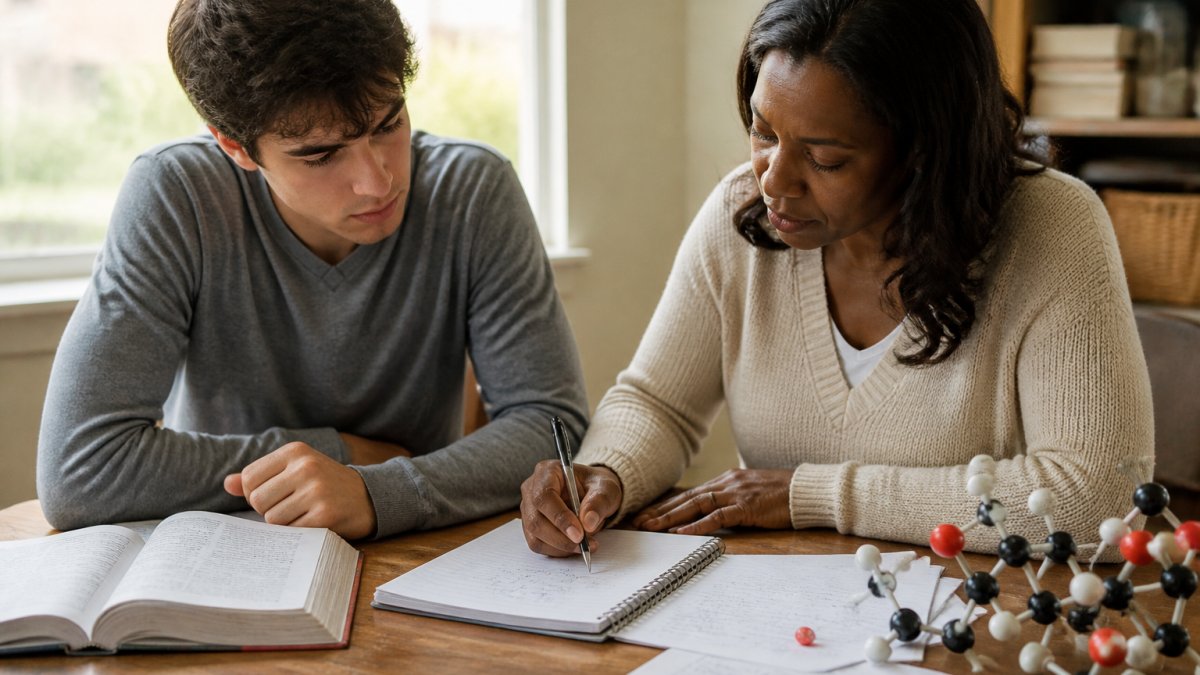
A chemistry tutor with subject expertise can watch you solve a problem and catch the exact step where you go wrong. That's hard to get from an answer key.
What a strong tutor brings:
- Personalized support matched to your course
- Concept reinforcement on weak units
- Test-taking strategy for free-response sections
- Progress tracking across sessions
Our founder is a former university chemistry professor and organic chemistry research scientist with more than 30 years of experience. That background matters when a student needs a concept explained three different ways.
Cost, Time, and Results: A Side-by-Side Comparison
Most guides compare tutoring and self-study with vague labels. A transparent breakdown against the same criteria is more useful, so here is how the two approaches actually differ on money, hours, feedback, and outcomes.
| Factor | Self-Study | Online Tutoring |
|---|---|---|
| Upfront cost | Free to low (textbook, prep book, AP Classroom) | Recurring session fees |
| Weekly time | 5-8 hours | 3-5 hours plus sessions |
| Feedback speed | Delayed (answer keys, released rubrics) | Immediate, live correction |
| Free-response coaching | Limited unless you self-grade against rubrics | Built into sessions |
| Progress tracking | Self-logged, easy to misjudge | Tutor-reviewed, tied to exam criteria |
| Best for | Disciplined, self-motivated students | Students who stall, fall behind, or plateau |
| Weak spot | Free-response reasoning and error diagnosis | Requires scheduled commitment and budget |
On cost, the honest comparison is not just the sticker price of a session versus a free video. Self-study still carries real costs: a college-level textbook, a prep book with practice exams, and the hours you spend re-teaching yourself a concept a tutor could have clarified in minutes. Tutoring shifts that cost from your time to your wallet, and the trade-off only pays off if you use sessions on the units where you are actually stuck.
On time, self-study looks cheaper on paper but often takes longer per topic because you absorb the feedback delay. Tutoring compresses the stuck time, which is why many students report fewer total weekly hours even with sessions added.
On results, the measurable difference shows up in free-response performance. Released scoring guidelines award points for specific reasoning steps, and students working alone frequently lose credit without knowing why. A tutor who has internalized those rubrics can name the missing step in real time.
Pricing for our lessons is listed on our website, and we offer a free trial so you can see the fit before committing.
A Hybrid Approach: Tutoring Plus Independent Practice
The strongest results usually come from a hybrid plan: tutoring for the hard parts, independent practice for the rest.
Use sessions to untangle equilibrium, thermodynamics, and electrochemistry. Then practice those units alone until they're automatic.
A hybrid week might look like:
- One tutoring session on your weakest unit
- Three solo practice blocks of 45 minutes
- One timed free-response question, reviewed in your next session
This keeps cost down while keeping feedback in the loop. Students preparing for the AP exam get both structure and independence.
Frequently Asked Questions
Can you get a 5 on AP Chemistry through self-study?
It is possible, but it requires disciplined use of a college-level textbook, AP Classroom materials, and regular timed practice with AP Chemistry practice questions. Self-study works best for students who already have a strong foundation from Honors Chemistry and can stick to a structured AP Chemistry study plan. Most students who earn a 5 combine independent work with some form of guided support, especially for free-response questions and lab-based concepts.
How many hours should I study for AP Chemistry each week?
Most students need 6 to 10 hours per week outside class to keep pace with AP Chemistry, depending on prior knowledge and target score. If you are self-studying without a course, plan for 8 to 12 hours weekly to cover new material, review older units, and work through practice questions. Online AP Chemistry tutoring can reduce total study time because sessions target weak areas directly instead of re-reading chapters you already understand.
When should I get a tutor for AP Chemistry?
Get a tutor when self-study stops producing measurable progress: scores on practice questions plateau, free-response answers consistently miss points, or test-day anxiety overrides what you actually know. A chemistry tutor with subject expertise can diagnose gaps, reinforce challenging concepts like balancing equations and thermodynamics, and build exam confidence through guided practice. Earlier intervention, ideally by fall or early spring, leaves more time to close gaps before the AP exam.
Is an online tutor worth it for AP Chemistry?
Online tutoring is worth it when you need personalized support that self-study cannot provide: real-time feedback on problem-solving, explanations of challenging concepts, and a study schedule built around your course. Look for a tutor with teaching certification or advanced chemistry credentials and experience with the current AP exam format, including digital exams and free-response scoring. Many students find that a few focused sessions per month, paired with independent practice, deliver better results than hours of unstructured review.
AP Chemistry rewards students who get feedback early and practice consistently. If your child is stuck, falling behind, or blanking on test day, guessing at a fix wastes the weeks that matter most. Chemistry Lessons by Annise offers personalized instruction, exam-focused practice, and progress tracking from a tutor with over 30 years of experience and nearly 290 five-star reviews. Request a lesson today and turn confusion into confidence.