 Ultimate guide
How to Prepare for the AP Chemistry Exam: A Complete Guide
Last Updated: November 21, 2026
Quick Summary
To prepare for the AP Chemistry exam, build an eight-to-twelve-week study plan at six to eight hours per week, weighting equilibrium, thermodynamics, and acid-base reasoning most heavily. Finish with two weeks of timed practice and error review, sorting every miss into content, application, or execution errors.
- Each exam section contributes half of your composite score, so neither can rescue the other.
- In a four-week window, spend the first week on equilibrium and acids and bases.
- Run your first practice exam untimed and open-book, marking every unsure answer.
- Free-response points require justification, setup, units, and correct significant figures.
- Never leave a multiple-choice question blank, since wrong answers carry no penalty.
Table of Contents
- What the AP Chemistry Exam Actually Tests
- Building Your AP Chemistry Study Plan
- AP Chemistry Formulas You Need Fluent, Not Memorized
- How to Use an AP Chemistry Practice Exam to Diagnose Weak Spots
- AP Chemistry Free-Response Questions: Strategy That Earns Points
- Exam-Day Strategy and the Mistakes That Cost Points
- Getting Expert Help When Self-Study Stalls
- Frequently Asked Questions
What the AP Chemistry Exam Actually Tests
The AP Chemistry exam is a college-level assessment of your ability to explain, model, and calculate chemical behavior across nine units, and the single biggest mistake students make is treating it as a vocabulary test. This guide covers how the exam is built, how it is scored, and how to prepare for the AP Chemistry exam without wasting weeks on the wrong material.
Here is the first thing to understand: the exam rewards reasoning, not recall. You will be asked to predict properties, justify claims with evidence, and connect particulate-level models to observable lab results.
The good news is that the exam is predictable in structure. Once you know where the points live, you can aim your study time at them instead of spreading effort evenly across everything.
Exam Structure and Scoring
The exam has two sections, and both matter. Section I is multiple choice, Section II is free response, and each contributes half of your composite score. The multiple-choice section rewards speed and pattern recognition; the free-response section rewards clear justification and correct significant figures.
Scoring runs through a composite that maps to a 1-5 scale, and colleges set their own credit policies for the scores. Because the weighting is even, a student who is strong in one section but weak in the other leaves easy points behind. The College Board's AP Chemistry course and exam description is the authoritative source for current timing, question counts, and the scoring rubric, and it should be your first download.
For a full breakdown of section timing and question counts, see 9 AP Chemistry Exam Format Details Every Student Should Know.
The Nine Units and Where the Weight Sits
The course framework splits into nine units, and the weighting is not equal. Atomic structure and properties, molecular and ionic compound structure, and intermolecular forces form the foundation. Chemical reactions, kinetics, thermodynamics, and equilibrium carry the heaviest reasoning load and show up constantly in free response. Acids and bases and applications of thermodynamics close the course.
What most guides miss is that the units are not independent. An equilibrium question is usually a thermodynamics question in disguise. A titration problem tests stoichiometry, acid-base chemistry, and particulate reasoning at once. Study the connections, not the chapters.
Building Your AP Chemistry Study Plan
A workable AP Chemistry study plan runs eight to twelve weeks at roughly six to eight hours per week, with the final two weeks reserved for timed practice and error review. That pacing fits a school schedule without demanding heroics, but the block schedule most guides publish is too vague to follow. What matters is which unit gets which week, what you produce by Friday, and what you do when you have less time than the ideal.
Build the plan backward from your exam date and anchor each week to a unit and a deliverable:
- Weeks 1-2 (Units 1-2): Atomic structure and properties, then molecular and ionic compound structure and properties. Deliverable: a one-page model sheet showing how you draw Lewis structures, assign formal charge, and predict geometry from electron domains.
- Weeks 3-4 (Units 3-4): Intermolecular forces and properties, then chemical reactions. Deliverable: a table matching each IMF to a measurable property (boiling point, vapor pressure, solubility) and a set of net ionic equations written from word problems.
- Weeks 5-6 (Units 5-6): Kinetics, then thermodynamics. Deliverable: rate-law problems solved from initial-rate data and a calorimetry set where you track sign conventions on q and ΔH.
- Weeks 7-8 (Units 7-8): Equilibrium, then acids and bases. Deliverable: ICE tables for Kc, Kp, and Ka, plus a titration curve sketch you can annotate from memory.
- Week 9 (Unit 9): Applications of thermodynamics. Deliverable: Gibbs free energy problems that connect ΔG to spontaneity and to K.
- Weeks 10-11: Full-length timed practice, one section per sitting, followed by the error sort described in the practice-exam section below.
- Week 12: Error review only. No new content, no new practice tests.
If you have four weeks instead of twelve, compress by priority rather than by page count. Spend the first week on Units 7-8 (equilibrium and acids and bases) because they generate the heaviest free-response load, the second week on thermodynamics and kinetics, the third on Units 1-4 as supporting material, and the final week on timed sections and error review. Unit 9 is short and usually folds into the thermodynamics review.
Watch out: students who "review everything equally" in a four-week window finish with shallow coverage of the units that actually carry the free-response points.
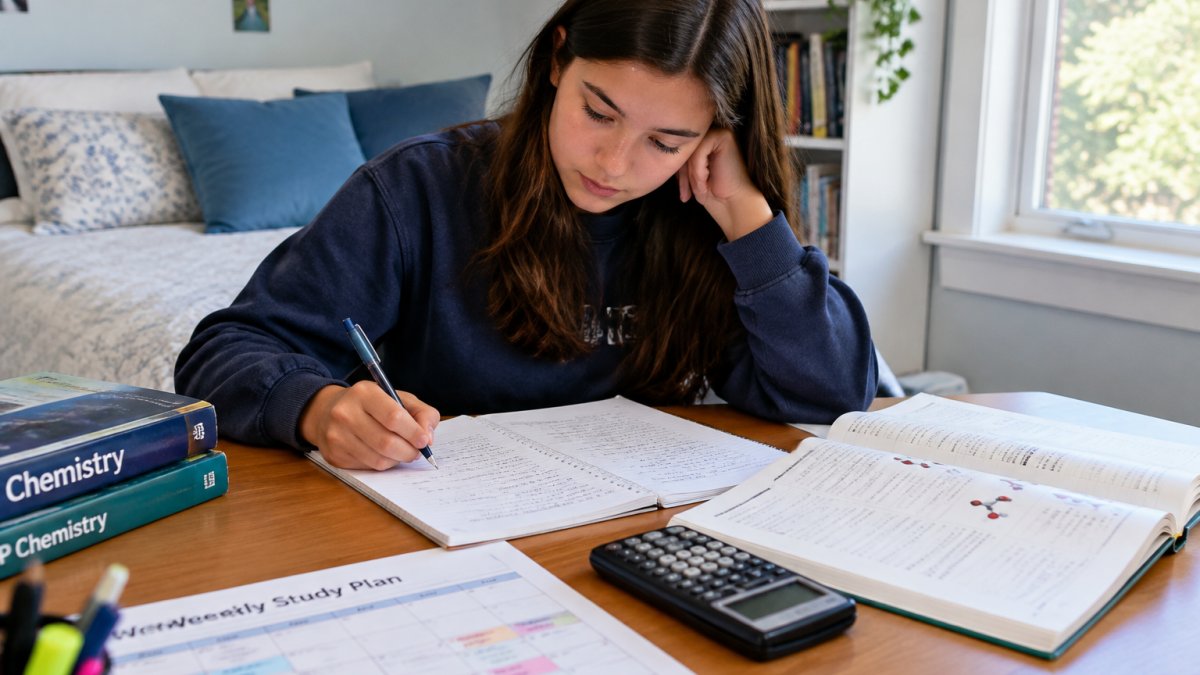
For a schedule you can adapt to your own timeline, follow How to Study for AP Chemistry: A Step-by-Step Plan.
AP Chemistry Formulas You Need Fluent, Not Memorized
You do not need to memorize most formulas, because the exam provides a reference sheet.
The formulas that trip students up are rarely the complicated ones.
A useful test: can you explain what each variable physically represents, and what happens to the result if one variable doubles? If you cannot answer both, you know the formula but do not understand it.
How to Use an AP Chemistry Practice Exam to Diagnose Weak Spots
An AP Chemistry practice exam is a diagnostic tool, not a score predictor, and students who treat it as a grade miss its entire value.
Run the first practice exam in two stages. Stage one is untimed and open-book: mark every question you were unsure about, even the ones you got right, because a lucky guess is a hidden gap. Stage two, a week later, is a timed section under real conditions, including the calculator rules and the reference sheet you will actually have on exam day.
Then sort every miss into three buckets:
| Error Type | What It Looks Like | What to Do |
|---|---|---|
| Content gap | You never learned the concept | Revisit the unit and do targeted problems |
| Application error | You knew the concept but chose the wrong tool | Practice mixed-topic problem sets |
| Execution error | Wrong units, sig figs, or misread question | Drill under timed conditions |
Most students assume they have content gaps when they actually have application errors.
Score the exam the way the real one is scored.
Keep an error log with four columns: question number, unit, error type, and the one-sentence rule you will apply next time. Review the log before each subsequent practice sitting. A common pattern is that the same two or three rules account for most of the lost points, and rewriting those rules in your own words is more useful than rereading a chapter.
Watch out: taking practice exams back to back without an error-review pass produces score noise, not improvement.
Choose your practice material from a vetted list like 7 Best AP Chemistry Practice Tests for 2026.
AP Chemistry Free-Response Questions: Strategy That Earns Points
AP Chemistry free-response questions are scored point by point, and every point has a defined requirement. You earn credit for what you write, not for what you meant, so clarity beats cleverness every time.
Three habits separate high scorers:
- Answer the question asked. If it says justify, a calculation alone earns nothing.
- Show the setup. Partial credit lives in the intermediate steps.
- Use correct units and significant figures. Points are routinely lost on the last line.
The long free-response questions often chain multiple units together. Read the whole question first, then answer in order, because later parts frequently depend on an earlier result. If you get stuck, write the governing equation and move on; that setup often earns a point by itself.
Exam-Day Strategy and the Mistakes That Cost Points
Exam-day mistakes cost more points than content gaps, and most of them are preventable.
Work in passes. Answer everything you can solve quickly, flag the rest, then return. Never leave a multiple-choice question blank, since there is no penalty for a wrong answer.
Watch out: skipping units on a final answer is the single most common avoidable loss.
For targeted multiple-choice tactics, review AP Chemistry MCQ Tips for Higher Scores on Exam Day.
Getting Expert Help When Self-Study Stalls
Self-study stalls for a predictable reason: you cannot diagnose your own blind spots. A student who misunderstands intermolecular forces will misread every question that depends on them and never know why.
This is where individualized instruction changes the trajectory.
If you are weighing the two paths, Online AP Chemistry Tutoring vs Self Study: 2026 Guide lays out the trade-offs honestly.
The difference between a 3 and a 5 is rarely intelligence. It is diagnosis: knowing precisely which reasoning breaks down and fixing that, week by week. Chemistry Lessons by Annise builds that plan around your course, your exam date, and your specific gaps, with personalized instruction, in-person sessions on Long Island, and online tutoring that works the same way. Get started with Chemistry Lessons by Annise and turn confusion into confidence before exam day.
Frequently Asked Questions
Is 70% a 5 on the AP Chemistry exam?
No. A 70% raw score does not map to a 5. The College Board sets score cutoffs each year after the exam is scored, and they shift with exam difficulty. Treat 70% as a practice-test result that does not guarantee a 5. Check the College Board's current scoring information for exact cutoffs.
How much time should I spend studying for AP Chemistry?
Plan on 8 to 12 weeks of structured work at about 6 to 8 hours per week, which is enough to cover all nine units and still leave room for practice tests. If you are already behind in the course, add a review block for the units you missed. Consistency matters more than long single sessions: four 90-minute blocks beat one six-hour cram. Build your AP Chemistry study plan around your actual test dates and any other AP exams you are sitting.
How do I improve my score on AP Chemistry practice tests?
Stop taking practice tests for the score and start using them for diagnosis. After each AP Chemistry practice exam, log every missed question by unit and by error type: content gap, misread question, calculation slip, or ran out of time. If most misses cluster in two units, those units get the next week of study. Retake the same exam two to three weeks later and compare. Students who track errors this way usually see faster gains than students who keep taking fresh tests.
What is the 5% rule in AP Chemistry?
The 5% rule is a shortcut for equilibrium problems: if the change in concentration (x) is less than 5% of the initial concentration, you can approximate the denominator by dropping x and avoid solving a quadratic. It is a calculation convenience, not a scoring rule. Show your approximation reasoning on free-response questions, because graders award points for the setup. If the change is close to or above 5%, solve the full expression instead.
What topics should I review for the AP Chemistry exam?
The course covers nine units: atomic structure and properties, molecular and ionic compound structure, intermolecular forces, chemical reactions, kinetics, thermodynamics, equilibrium, acids and bases, and applications of thermodynamics. Do not spread review evenly. Kinetics, thermodynamics, equilibrium, and acids and bases carry the most free-response weight and reward repeated practice. Atomic structure and bonding questions are usually faster points, so review them early and keep them sharp with short weekly drills.
How can I practice AP Chemistry free-response questions?
Work released free-response questions under timed conditions, then grade yourself against the official scoring guidelines line by line. The guidelines show exactly where points live, and most lost points come from missing justification, not wrong answers. Write full sentences where explanation is asked, label units, and show setup steps. Aim to complete four to six full free-response sets before exam day, rotating through kinetics, equilibrium, thermodynamics, and acid-base prompts.