 How-to
AP Chemistry MCQ Tips for Higher Scores on Exam Day
Last Updated: November 10, 2026
Quick Summary
The ap chemistry mcq section is 60 questions in 90 minutes, so you have about 90 seconds per question. Build speed with timed practice sets and budget time by question type, not by question number. Review every miss in a written error log so you fix the cause, not just the answer.
- Section I is 60 multiple-choice questions and counts for half your total score.
- Set hard stops per question type, such as 60 seconds for periodic trends.
- Run three passes: answer easy questions, return to flagged ones, then verify entries.
- At 30 minutes aim for question 20; at 60 minutes, near question 40.
- Simulate the full exam at least twice with 60 questions in 90 minutes.
Table of Contents
- What the AP Chemistry MCQ Section Actually Tests
- Time Management Strategies for the 60-Question Section
- How to Use AP Chem MCQ Practice to Build Speed
- Where to Find AP Chemistry Past Multiple-Choice Questions
- Choosing an AP Chemistry Multiple-Choice Questions PDF
- Running a Full AP Chemistry Practice Exam MCQ Simulation
- Process of Elimination and Data-Driven Guessing
- Building an Error Analysis Workflow for Missed Questions
- Frequently Asked Questions
What the AP Chemistry MCQ Section Actually Tests
The AP Chemistry MCQ section is 60 multiple-choice questions that test whether you can apply chemical reasoning under time pressure, not whether you can recall isolated facts.
That works out to 90 seconds per question. The whole exam runs 3 hours and 15 minutes, per The Princeton Review's exam structure guide.
Strong students often lose points here for one reason: they study content but never study the question format. Those are two different skills.
Below, we break down exactly what each question type demands and how to practice for it.
Question Types You Will See
Most questions fall into five buckets:
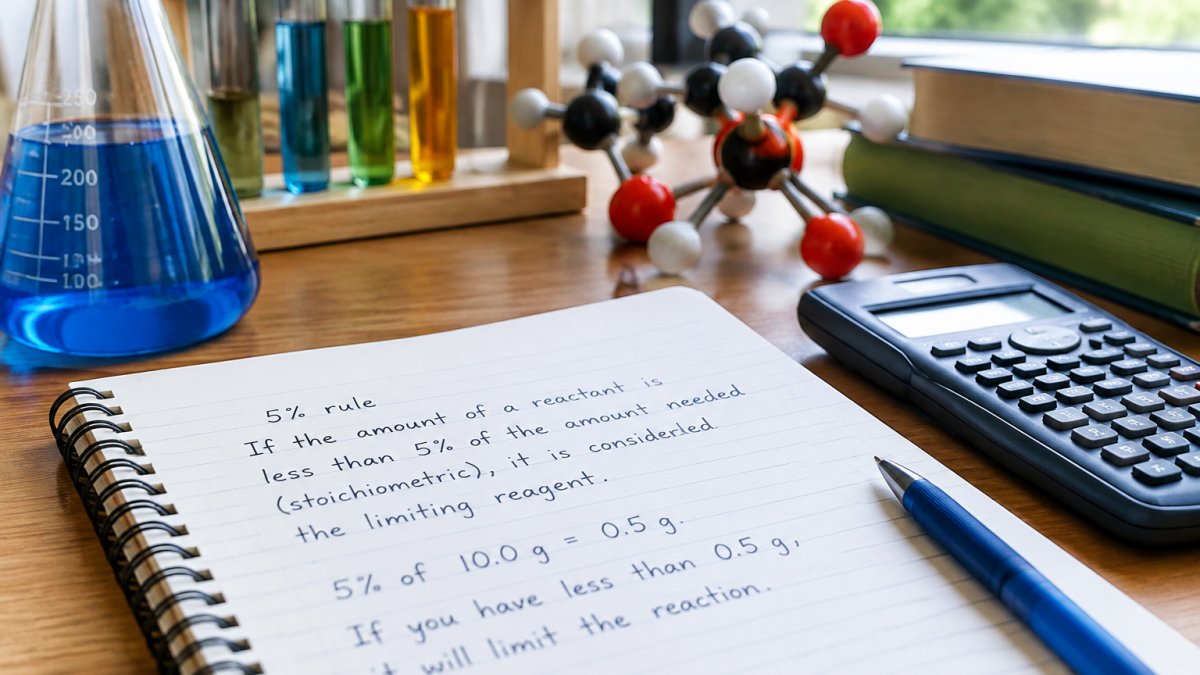
- Stoichiometry and chemical equations - limiting reactant and yield math
- Thermodynamics and equilibrium - enthalpy, entropy, and Le Châtelier shifts
- Molecular structure and intermolecular forces - Lewis structures, polarity, and boiling point trends
- Reaction kinetics and acid-base chemistry - rate laws and pH calculations
- Electrochemistry and periodic trends - cell potential and atomic radius patterns
Lab-based questions and data interpretation show up inside all five. You will read a graph, a table, or an experimental setup, then answer 2-3 questions about it.
How the Big Ideas Shape the Questions
The College Board organizes the course around Big Ideas: scale, proportion, and quantity; structure and properties; transformations; and energy. Every MCQ traces back to one of them.
This matters because distractors often target a Big Idea you mixed up, not a fact you forgot. Miss a periodic trend and you will see three answer choices that all look reasonable.
For the full picture of how Section I fits into the rest of the exam, see our breakdown of AP Chemistry exam format details.
Time Management Strategies for the 60-Question Section
Ninety minutes for 60 questions averages 90 seconds each, but that average hides the real pacing problem: question difficulty is not evenly distributed.
Start with a per-type pace target. Use per-type pace targets such as these as a starting point:
| Question type | Target pace | Hard stop |
|---|---|---|
| Periodic trends and atomic structure | 30-45 seconds | 60 seconds |
| Lewis structures and intermolecular forces | 45-60 seconds | 90 seconds |
| Stoichiometry and limiting reactant | 60-90 seconds | 2 minutes |
| Equilibrium and thermodynamics calculations | 75-90 seconds | 2 minutes |
| Kinetics and acid-base pH math | 60-90 seconds | 2 minutes |
| Electrochemistry and cell potential | 60-75 seconds | 90 seconds |
| Data and lab interpretation sets | 90-120 seconds per question | 2.5 minutes |
Those targets sum to roughly 75-80 minutes of work, which leaves a 10-15 minute buffer for flagged questions and transfer checks.
Run the section in three passes with explicit decision rules:
- Pass 1 (about 55 minutes): Answer every question you can resolve in under 60 seconds. The moment you hit the hard stop for that question type, mark it and move on. Do not reread the stem hoping it clicks.
- Pass 2 (about 25 minutes): Return to flagged questions in the order you flagged them, not in numerical order. Your first read already told you which ones were close.
- Pass 3 (about 10 minutes): Verify that every answer is bubbled or entered, check that no flagged question was left blank, and confirm you did not shift an answer by one row on the answer sheet.
Watch out: the most common pacing failure is not a slow start but a single stubborn question in the first 15 that consumes four minutes. That one question costs you three easy points at the end of the section, and the easy points are worth exactly the same.
Build a checkpoint habit during practice. At 30 minutes you should be near question 20; at 60 minutes, near question 40.
Calculator use interacts with pacing. The MCQ section allows a graphing calculator, but most questions are designed to be reasoned through without one.
How to Use AP Chem MCQ Practice to Build Speed
Speed comes from repetition with a timer, not from reading faster.
Start with 10 questions in 15 minutes. Log your time and accuracy. Then push to 20 in 30 minutes.
A common mistake is practicing untimed until the week before the exam. By then, pacing is a habit you cannot build overnight.
Mixing timed sets with untimed review is a useful approach. Timed sets build speed. Untimed review builds the conceptual understanding that makes speed possible.
If you want a full study structure to slot practice into, our step-by-step AP Chemistry study plan maps out how to sequence content review and timed drills.
Where to Find AP Chemistry Past Multiple-Choice Questions
Official AP Chemistry past multiple-choice questions are the best practice material you can get. The College Board releases free-response questions every year, and AP Classroom includes multiple-choice practice aligned to the current course framework.
According to AP Central's official exam resources, official questions and scoring guidelines are the primary way to understand the exam's rigor and format.
Third-party books help too, but treat them as supplements. Teacher-created classroom MCQs often feel easier than the real thing.
For a vetted list, see our guide to the best AP Chemistry practice tests.
Choosing an AP Chemistry Multiple-Choice Questions PDF
An AP Chemistry multiple-choice questions PDF is only worth downloading if it matches the current course framework and includes answer explanations. Skip any file with no answer key.
Use this checklist before you commit study time to a PDF:
- Questions are labeled by unit or Big Idea
- Every answer has an explanation, not just a letter
- The file states which exam year or framework it follows
- At least one full 60-question set is included
- No obvious typos in chemical formulas or units
A PDF with 500 questions and no explanations is worse than 60 questions with clear reasoning. You learn from the why, not the what.
Running a Full AP Chemistry Practice Exam MCQ Simulation
Simulate the real thing at least twice before exam day. Sit for 60 questions in 90 minutes, no phone, no notes, no breaks.
Use a real timer and a quiet room. Treat every question as scored, even the ones you guess on.
Afterward, score it honestly. Our guide on whether 70% is a 5 on AP Chem explains how raw practice scores translate.
The simulation does two things a short practice set cannot. It trains your stamina for a 90-minute block, and it exposes pacing problems you would never notice in a 10-question drill.
Process of Elimination and Data-Driven Guessing
Process of elimination beats guessing every time, but only if you eliminate for a reason.
A data-driven guess means using the question's own numbers. If a calculation gives you 0.5 mol and only one answer is near that, pick it.
One contrarian tip from students on the r/APChem subreddit: avoid "cannot be determined" as an answer.
We agree with the spirit of that advice, with one caveat. If a question genuinely lacks data, do not force a number. Read carefully first.
If test-day panic is your real problem, our guide on overcoming test anxiety in chemistry covers breathing and reframing techniques that help during the MCQ section.
Distractor Patterns to Recognize
Distractors follow predictable patterns. Learn them and you will spot wrong answers faster.
- Unit traps - the number is right but the units are wrong
- Sign errors - a positive enthalpy where it should be negative
- Reverse trends - electronegativity listed in the wrong direction
- Half-solved math - the answer stops before the final step
- Plausible but unrelated - a true fact that does not answer the question
Distractor analysis is a skill. Practice naming why each wrong answer is wrong, not just why the right one is right.
Building an Error Analysis Workflow for Missed Questions
Most guides tell you to review your mistakes. Almost none tell you how to review them in a way that changes your next score.
Use a written error log with five columns. Paper or a spreadsheet both work; the format matters less than the discipline of filling every column for every miss.
| Column | What goes in it |
|---|---|
| Question and topic | Number, unit, and the specific concept (for example, "limiting reactant with percent yield") |
| Error type | Content gap, misread stem, math or unit slip, distractor trap, or educated guess that failed |
| Correct reasoning | One sentence stating the principle that solves it, in your own words |
| Big Idea tag | Scale/proportion/quantity, structure/properties, transformations, or energy |
| Retry date | The date you will reattempt a fresh question on that concept |
The error type is the column students skip, and it is the one that drives the fix. Each type points to a different remedy:
- Content gap: You did not know the principle. Schedule a review of that unit and reattempt five fresh questions on it within a week.
- Misread stem: You knew the chemistry but answered a different question than the one asked. The fix is a reading habit, not more content: underline the quantity requested and the units before looking at the choices.
- Math or unit slip: The setup was right and the arithmetic or conversion failed. The fix is a unit check at the end of every calculation, plus a habit of estimating the answer before computing.
- Distractor trap: You picked a choice that was true but did not answer the question, or that reversed a trend. The fix is naming why each wrong choice is wrong during review, not just why the right one is right.
- Failed guess: You had no path to the answer. Treat this as a content gap even if you happened to guess correctly on a similar question.
Set a review cadence instead of reviewing once.
Watch out: reviewing a missed question by rereading the explanation feels productive but leaves no trace.
Track two numbers across practice sets: raw accuracy and the share of misses that are content gaps versus careless errors. If careless errors dominate, your problem is process and pacing, not knowledge, and more content review will not move the score. If content gaps dominate, slow down and rebuild the weak units before adding timed volume.
Frequently Asked Questions
How hard is the AP Chemistry MCQ section?
Section I holds 60 multiple-choice questions, and the full exam runs 3 hours and 15 minutes, so the MCQ section moves fast. Classroom MCQs often feel more manageable than official exam questions, largely because the official questions test conceptual application across stoichiometry, equilibrium, thermodynamics, and intermolecular forces rather than recall. Practicing with official College Board questions is the most reliable way to calibrate difficulty before exam day.
Is there a trick for AP Chemistry multiple-choice questions?
There is no shortcut that replaces content knowledge, but a repeatable workflow helps. Read the question stem first, predict the answer before looking at the choices, then eliminate distractors that misuse units, significant figures, or scientific notation. One common habit is avoiding cannot be determined as a default pick, since most items are solvable through chemical principles. Pair that with timed AP Chem MCQ practice and the process becomes automatic.
How many AP Chemistry practice questions should I do each day?
Quality beats volume. A workable routine is 15 to 20 questions per session, timed, followed by a full error analysis of every miss. That gives you enough volume to build exam pacing without burning through limited official AP Chemistry past multiple-choice questions. Save full 60-question sets for weekly AP Chemistry practice exam MCQ simulations, and spend the rest of your study time reviewing the concepts behind each wrong answer.
How should I review missed AP Chemistry MCQs?
Log every miss in three columns: the topic, the reason you chose the wrong answer, and the correct reasoning. Group the reasons into categories such as misread question, calculation slip, or missing concept, then target the largest category first. This error analysis workflow turns a stack of AP Chemistry multiple-choice questions PDF printouts into a study plan. Bring the log to tutoring sessions so instruction focuses on your actual gaps rather than a general review.