
 How-to
What Is the 5% Rule in AP Chem?
Last Updated: November 5, 2026
Quick Summary
The 5% rule in AP Chem is a percent-change check that confirms whether ignoring x in an equilibrium expression was a safe move. You solve first assuming x is negligible, then divide x by the initial concentration and multiply by 100; if the result is 5% or less, the approximation is valid.
- The 5% rule is a validation test, not a step you apply before solving.
- Divide x by the initial concentration of the species you approximated, then multiply by 100.
- If the check exceeds 5%, redo the problem with the full expression and the quadratic formula.
- Weak base problems give you hydroxide, so convert to pOH and then pH.
- Show the check as a labeled line in free-response work so graders see you validated the assumption.
Table of Contents
- What the 5% Rule Actually Says
- How the 5% Approximation Rule Works in AP Chemistry
- Setting Up a Weak Acid Equilibrium ICE Table
- Running a Weak Base Equilibrium Calculation Step by Step
- The Equilibrium Concentration Approximation: Checking and Validating It
- When the 5% Rule Fails: The Quadratic Fallback
- Common Mistakes and How to Troubleshoot Them
- Request a Lesson to Master the 5% Rule
- Frequently Asked Questions
What the 5% Rule Actually Says
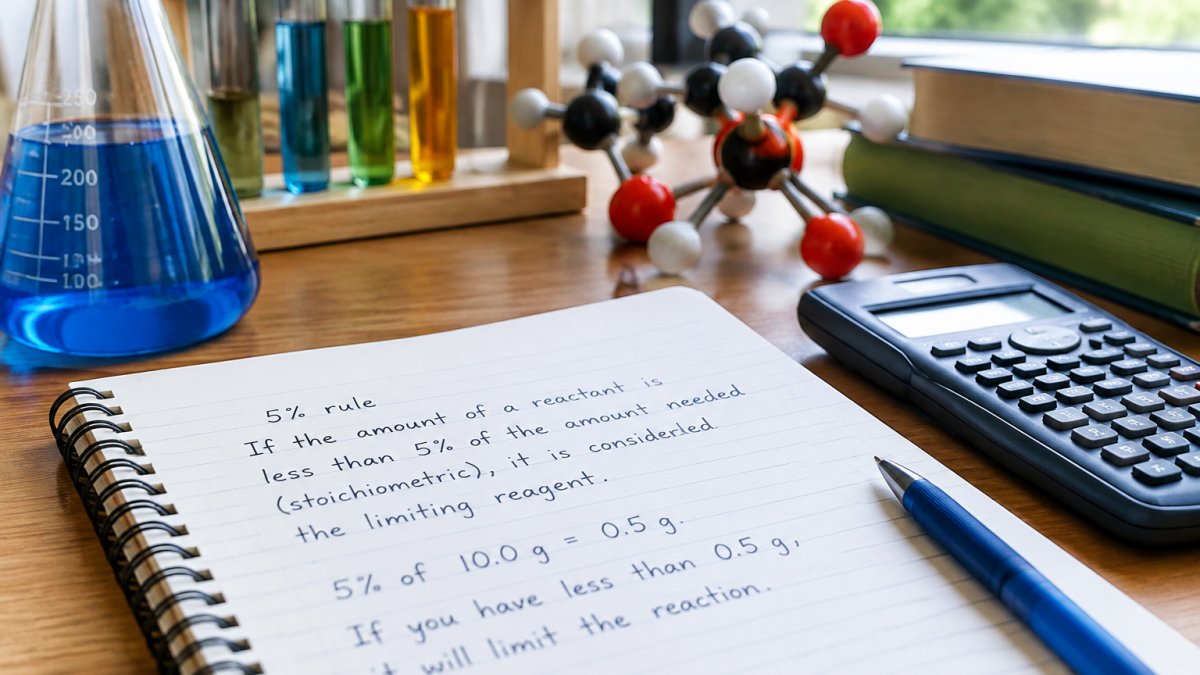
The 5% rule in AP Chem is a shortcut for checking whether you can drop the "x" term in an equilibrium calculation. If the change in concentration is less than 5% of the starting concentration, the approximation is considered valid.
That is the whole idea. It is a test, not a step you perform.
Here is where students get confused. Many treat the 5% rule as something you apply before solving. It is not. You solve first, assuming x is tiny, then check whether that assumption held up.
Adrian Dingle, a chemistry educator, argues on his equilibrium and AP Chemistry page that there is no "5% rule" that must always be applied, and that unless a problem states otherwise, x is often simply assumed negligible.
So the rule is a validation tool. Nothing more.
The 5% rule in AP Chem is a percent-change check that confirms whether ignoring x in an equilibrium expression was a safe move.
How the 5% Approximation Rule Works in AP Chemistry
The 5% approximation rule AP Chemistry students use follows one logic: small x means small disruption.
When K is very small, the reaction barely moves toward products. The change in concentration stays tiny compared with what you started with. That lets you simplify the equilibrium expression.
Take a weak acid with a small Ka. The expression looks like this before simplifying:
Ka = x² / (initial concentration − x)
If x is negligible, the denominator becomes just the initial concentration:
Ka ≈ x² / initial concentration
That second version is easy to solve. No quadratic formula needed.
But the simplification only holds if x really is small. The 5% check tells you whether it was.
Setting Up a Weak Acid Equilibrium ICE Table
A weak acid equilibrium ICE table organizes the math into three rows: initial, change, equilibrium. Get this right and the rest of the problem follows.
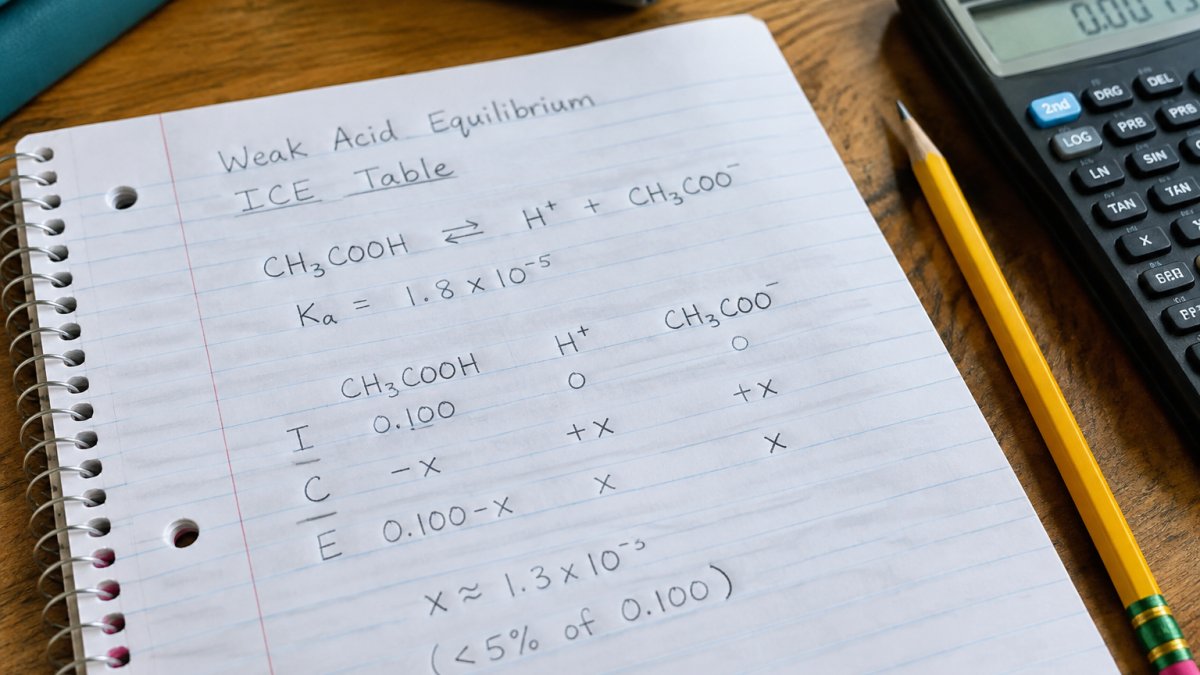
Set it up in this order:
- Initial: write the starting acid concentration. Products start at zero.
- Change: subtract x from the acid, add x to each product.
- Equilibrium: combine the two rows into expressions with x.
For a weak acid HA dissociating into H⁺ and A⁻, the equilibrium row gives you:
- [HA] = initial − x
- [H⁺] = x
- [A⁻] = x
Then plug those into Ka = [H⁺][A⁻] / [HA].
Here is the setup carried through with numbers. Acetic acid has Ka = 1.8 × 10⁻⁵. Suppose you start with 0.10 M CH₃COOH.
| CH₃COOH | H⁺ | CH₃COO⁻ | |
|---|---|---|---|
| Initial | 0.10 | 0 | 0 |
| Change | −x | +x | +x |
| Equilibrium | 0.10 − x | x | x |
The Ka expression becomes 1.8 × 10⁻⁵ = x² / (0.10 − x). Assume x is negligible next to 0.10, so the denominator stays 0.10. Then x² = 1.8 × 10⁻⁶, and x = 1.3 × 10⁻³ M. That x is [H⁺], so pH = −log(1.3 × 10⁻³) ≈ 2.89.
Now run the check: (1.3 × 10⁻³ / 0.10) × 100 = 1.3%, well under 5%, so the approximation held. If the same setup had started at 0.010 M, x would have come out closer to 4.2 × 10⁻⁴ M and the percent would climb past 4%, still valid but close enough that you should show the check explicitly on a free-response answer.
Watch out: forgetting that water contributes to H⁺ in some setups. In most weak acid problems, that contribution is ignored, but know when it matters, for very dilute acids, the autoionization of water can supply more H⁺ than the acid itself.
Running a Weak Base Equilibrium Calculation Step by Step
A weak base equilibrium calculation mirrors the acid version, with Kb in place of Ka and hydroxide in place of hydrogen ion.
Work through it this way:
- Write the base ionization equation. For B + H₂O ⇌ BH⁺ + OH⁻, the base grabs a proton.
- Build the ICE table with initial, change, and equilibrium rows.
- Write Kb = [BH⁺][OH⁻] / [B].
- Assume x is small and simplify.
- Solve for x, which equals [OH⁻].
- Convert to pOH, then pH.
The last step trips people up. Solving for x gives you hydroxide concentration, not pH directly. You need pOH = −log[OH⁻], then pH = 14 − pOH.
Skip that conversion and your answer looks right but is wrong by a wide margin.
The Equilibrium Concentration Approximation: Checking and Validating It
Here is the part most guides rush past. The equilibrium concentration approximation only counts if you prove it worked, and the proof has a precise form.
The approximation is the assumption that x is negligible, so you drop it from the denominator. The 5% rule is the test you run afterward to confirm that assumption was safe. They are not the same thing, and conflating them is the single most common conceptual error on this topic.
The test is one calculation:
|x| / [initial concentration being approximated] × 100 ≤ 5% |
The denominator is the initial concentration of the species whose equilibrium expression you simplified, not the equilibrium concentration and not the other reactant. If you approximated 0.10 − x as 0.10, divide by 0.10.
Work it through with the acetic acid example. x = 1.3 × 10⁻³ M and the initial concentration is 0.10 M, so (1.3 × 10⁻³ / 0.10) × 100 = 1.3%. That is at most 5%, so the approximation is valid and the answer stands.
Now suppose the check fails. Take a weak acid with Ka = 1.0 × 10⁻³ at 0.10 M. The simplified solve gives x² = 1.0 × 10⁻⁴, so x = 1.0 × 10⁻² M. The check is (1.0 × 10⁻² / 0.10) × 100 = 10%, which exceeds 5%. The approximation is invalid, and you must redo the problem with the full expression: 1.0 × 10⁻³ = x² / (0.10 − x). Rearranged, x² + 1.0 × 10⁻³·x − 1.0 × 10⁻⁴ = 0. The quadratic formula gives x ≈ 9.5 × 10⁻³ M, about 5% lower than the shortcut value, enough to change a reported pH by roughly 0.02 units and enough to lose points if the check was skipped.
A few operational details matter on the AP Chemistry exam. Carry at least three significant figures through the solve so the percent check is not thrown off by rounding. Show the check as a labeled line in free-response work, because graders look for evidence that you validated the assumption rather than assumed it blindly. And remember the check is not a substitute for solving the equilibrium, you still need x before you can test it.
Students who want extra reps on this check can work through practice tests for AP Chemistry to build the habit.
The 5% rule and the approximation are two different things: the approximation is the shortcut, and the 5% rule is the test that proves the shortcut was allowed.
When the 5% Rule Fails: The Quadratic Fallback
The 5% rule fails when x is too large to ignore. That usually means K is not small or the acid or base is relatively strong.
In those cases, dropping x changes the answer too much. You need the full expression:
Ka = x² / (initial − x)
Rearrange it into standard quadratic form:
x² + Ka·x − Ka·initial = 0
Then solve with the quadratic formula. Yes, it is more work. But it gives the correct answer when the shortcut cannot.
A quick rule of thumb: if K is close to the initial concentration in size, expect the approximation to break. Very small K values are where the shortcut earns its keep.
If approximations keep costing you points and your grade is slipping, steps to improve AP Chemistry grades can help you rebuild the fundamentals.
Common Mistakes and How to Troubleshoot Them
Most errors with the 5% rule come from skipping steps or misreading what the rule tests. Here are the ones we see most often.
- Applying the rule before solving. The check comes after you find x, not before.
- Forgetting to multiply by 100. A raw ratio of 0.04 is 4%, not 4 as a percent.
- Dividing by the wrong number. Use the initial concentration, not the equilibrium concentration.
- Ignoring a failed check. If the percent is 5% or higher, you must redo the problem with the quadratic.
- Mixing up Ka and Kb setups. Weak bases give [OH⁻], so convert to pH at the end.
When the same errors keep repeating, a broader study plan helps more than drilling one problem type. Our guide on how to study for AP Chemistry walks through a step-by-step approach to close those gaps.
Request a Lesson to Master the 5% Rule
The 5% rule is small, but it decides whether an entire equilibrium answer is right or wrong. Students who master the check stop losing points on avoidable errors.
At Chemistry Lessons by Annise, we teach this concept the way it is tested: solve, check, and know when to fall back to the quadratic. Our founder is a former university chemistry professor and organic chemistry research scientist with more than 30 years of experience, and we have tutored over 1,000 students. Nearly 290 five-star reviews reflect that work.
If you want to compare your options first, our guide on online AP Chemistry tutoring vs self study lays out the trade-offs.
Frequently Asked Questions
When should you use the 5% rule in an ICE table?
Use it after you set up the equilibrium expression and assume the change in concentration, x, is negligible. Solve for x, then divide it by the initial concentration and multiply by 100. If the result is 5% or less, the assumption holds and your simplified answer stands. If it comes out above 5%, the assumption is invalid and you need to solve the full expression, usually with the quadratic formula. The check is what makes the shortcut safe.
What is the difference between the 5% rule and the 5% approximation?
They describe the same shortcut from two sides. The 5% approximation is the move itself: dropping x from the denominator of the equilibrium expression because the change is tiny compared with the starting concentration. The 5% rule is the test that decides whether that move was allowed. Many students skip the test, which is where points get lost. Treat the approximation as the guess and the rule as the proof.
What does it mean if the change is greater than 5%?
It means x is too large to ignore, so the simplified expression no longer matches the real equilibrium. You have to go back to the unsimplified expression and solve it as a quadratic, then recalculate the equilibrium concentrations. A common sign is a weak acid or base that is fairly concentrated in H+ or OH- relative to its starting molarity, or a Ka or Kb that is not especially small.
How does the 5% rule apply to weak acids and bases?
For a weak acid equilibrium ICE table, you assume the dissociation is small, so the acid's equilibrium concentration stays close to its initial molarity. The same logic powers a weak base equilibrium calculation with Kb. The 5% rule is the check: if the amount that ionized is 5% or less of the starting concentration, the assumption is valid and the pH or pOH you calculated is reliable. If not, solve without the approximation.
The 5% rule rewards students who slow down and check their work. If equilibrium problems keep costing you points, we can help you build the habit that fixes it. Chemistry Lessons by Annise offers personalized instruction, in-person sessions on Long Island, and online tutoring that mirrors the face-to-face experience. Get started with Chemistry Lessons by Annise and turn equilibrium confusion into exam confidence.