 How-to
9 AP Chemistry Exam Format Details Every Student Should Know
Last Updated: November 2, 2026
Quick Summary
The AP Chemistry exam is a single-sitting, two-section test: 60 multiple-choice questions in 90 minutes, then 7 free-response questions in 105 minutes, with a short break between them. Each section counts for 50% of your score, and calculators are permitted on Section II only.
- Total testing time is 3 hours and 15 minutes, plus a short break.
- Multiple choice works out to about 1.5 minutes per question.
- Section II has 3 long questions at 10 points and 4 short at 4 points.
- A periodic table and formula sheet are provided for both sections.
- Answer easy multiple-choice questions first, then flag and return to calculations.
Table of Contents
- How the AP Chemistry Exam Is Structured
- AP Chemistry Exam Length: Timing Each Section
- AP Chemistry Exam Question Types You Will Face
- Calculator Rules and the AP Chemistry Formula Sheet
- AP Chemistry Exam Scoring: From Raw Points to Your Final Score
- Pacing Strategies for Each Question Type
- Common Format Mistakes That Cost Students Points
- Building a Study Plan Around the Exam Format
- Frequently Asked Questions
How the AP Chemistry Exam Is Structured
The AP Chemistry exam is a single-sitting, two-section test: a multiple-choice section followed by a free-response section, with a short break between them. The format has been stable for several years, but the details that trip students up are the ones worth pinning down before exam day: exact question counts, timing, weighting, calculator rules, and how the exam is delivered.
Here is the current format at a glance. Treat the College Board's official course and exam description as the source of truth.
| Component | Section I: Multiple Choice | Section II: Free Response |
|---|---|---|
| Questions | 60 | 7 (3 long, 4 short) |
| Time | 90 minutes | 105 minutes |
| Weight | 50% of score | 50% of score |
| Calculator | Not permitted | Permitted |
| Reference sheet | Periodic table and formula sheet provided | Periodic table and formula sheet provided |
| Question style | Standalone and set-based | Multipart, written response |
A few structural facts are worth calling out because they shape how you prepare:
- One sitting, one day. Both sections are taken back-to-back with a break. There is no separate lab practical or portfolio component.
- Equal weighting. Each section contributes half of your composite score, so a strong multiple-choice performance cannot fully offset a weak free-response section, and vice versa.
- Reference materials are provided. You receive a periodic table and a formula sheet for both sections. You are not expected to memorize constants and equations, but you are expected to know when to apply them.
- Delivery mode. Confirm your specific administration details, including approved accommodations, through your school's AP coordinator before exam day.
The rest of this guide breaks down each section, the timing math, the question types, calculator rules, and how raw points become your final 1-5 score.
AP Chemistry Exam Length: Timing Each Section
The AP Chemistry exam length totals 3 hours and 15 minutes of testing time. That is 90 minutes for Section I and 105 minutes for Section II, plus a short break between them.
Timing is where strong students lose ground. The multiple-choice section works out to about 1.5 minutes per question. The free-response section gives you roughly 15 minutes per long question and about 11 minutes per short one.
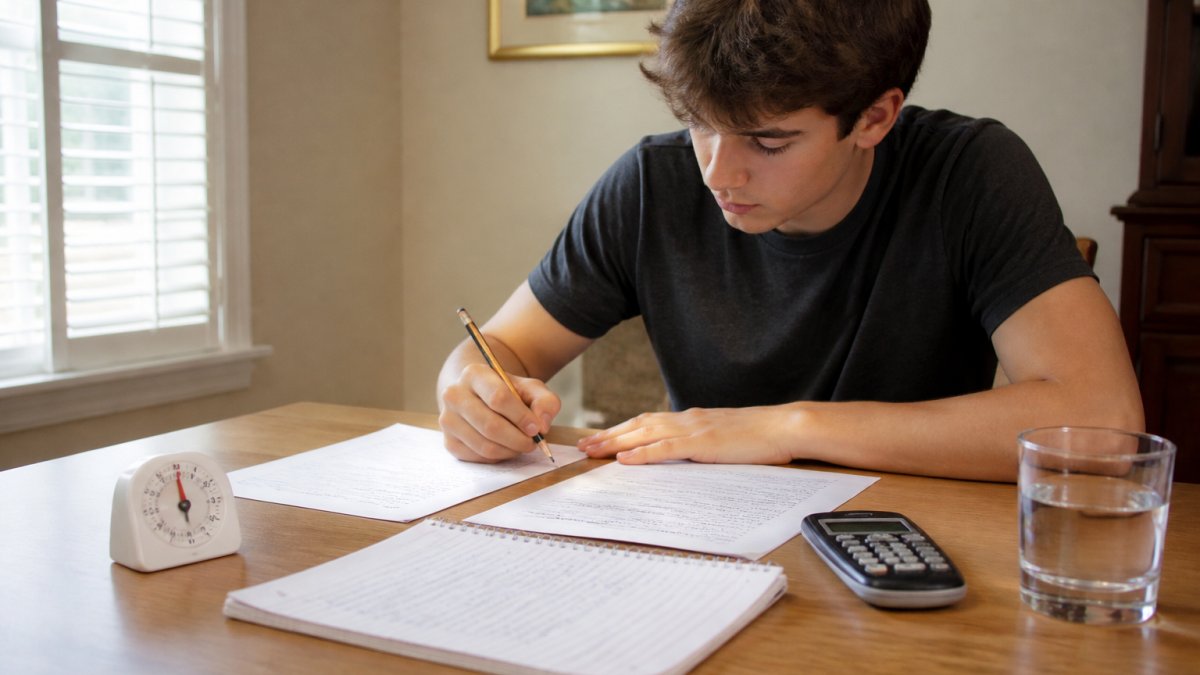
Watch out: students who spend four minutes on one multiple-choice calculation run out of time for ten easier questions. Keep moving.
AP Chemistry Exam Question Types You Will Face
The AP Chemistry exam question types fall into a few clear buckets. Knowing them changes how you study.
On the multiple-choice side, expect:
- Quantitative problems that need a calculation
- Conceptual questions about bonding, kinetics, and equilibrium
- Data interpretation from tables and graphs
- Experimental design and lab-based reasoning
The free-response side leans on explanation. You will write out setups, justify claims with evidence, and connect lab data to chemical principles. Once you know the question types, you can apply that knowledge with AP Chemistry practice tests.
Long-Response and Short-Answer FRQs
Long-response questions carry the most weight per item. They often give you a scenario, then ask several connected parts: predict, calculate, justify, and explain.
Short-answer questions test one skill at a time. They move quickly, and partial credit is real. Even a partial setup earns points.
The scoring rewards clear work. Write the equation, show the substitution, then give the answer with units. Graders at the AP Reading follow a rubric, and they can only award points for what they see on the page.
Calculator Rules and the AP Chemistry Formula Sheet
A calculator is allowed on Section II only, and the rules are strict. You may use a graphing or scientific calculator, but no built-in communication or internet features.
The AP Chemistry formula sheet is provided to you. You do not need to memorize every constant and equation. You do need to know when and how to use them.
What most guides miss: the formula sheet does not tell you which equation fits a problem. That judgment is the actual skill being tested. Practice choosing the right relationship before you plug in numbers.
AP Chemistry Exam Scoring: From Raw Points to Your Final Score
AP Chemistry exam scoring moves through three stages: raw points earned on each section, a weighted composite, and a final AP score of 1 through 5. Understanding each stage explains why two students with similar content knowledge can land on different scores.
Stage 1: Raw points. On Section I, each of the 60 multiple-choice questions is worth one point, with no penalty for wrong answers, so your raw multiple-choice score is simply the number correct out of 60. On Section II, the seven free-response questions carry fixed point values: three long questions at 10 points each and four short questions at 4 points each, for a Section II raw total of 46 points.
Stage 2: Weighted composite. Each section is converted to a percentage of its own maximum, then weighted at 50 percent. In practice, that means your Section I percentage and your Section II percentage are averaged to produce a composite score. A student who earns 45 of 60 on multiple choice (75 percent) and 30 of 46 on free response (about 65 percent) lands at a composite near 70 percent before the cutoff is applied.
Stage 3: The 1-5 scale. The College Board sets score cutoffs each year after the AP Reading, based on the difficulty of that year's exam and the performance of the full testing population. There is no published percentage that guarantees a 5, and cutoffs shift slightly from year to year. That is why a practice-test percentage is a rough guide, not a promise.
| Component | Raw Points | Weight in Composite |
|---|---|---|
| Section I (60 MCQ) | 60 | 50% |
| Section II (3 long FRQ × 10) | 30 | Part of 50% |
| Section II (4 short FRQ × 4) | 16 | Part of 50% |
| Section II total | 46 | 50% |
Where partial credit actually accrues. Free-response scoring is where most students gain or lose the most points, because each multipart question is scored against a rubric with point-by-point criteria. A long question worth 10 points might award one point for a correct setup, one for a correct substitution, one for the answer with units, and several more for justification and explanation. A short question worth 4 points might award one point each for a claim, evidence, calculation, and reasoning.
The practical implication is that blank or skipped parts are guaranteed zeros, while a partial setup with clear work often earns something. Graders at the AP Reading score only what appears on the page, so writing the equation, showing the substitution, and stating units are not cosmetic, they are the evidence the rubric rewards.
If you want to see how raw-to-scaled conversion plays out in practice, work through a released free-response set under timed conditions and score it against the published rubric before checking the scoring worksheet.
Pacing Strategies for Each Question Type
Pacing starts with a simple rule: never let one question eat another's time. Build a rhythm around each question type. To turn that rhythm into better results, see these proven steps to improve AP Chemistry grades.
Try this approach:
- Answer every multiple-choice question you can solve in under a minute first.
- Flag the calculation-heavy ones and return to them.
- On free-response, read all seven questions before writing.
- Start with the short-answer questions to bank quick points.
- Leave the hardest long-response question for last.
Common Format Mistakes That Cost Students Points
The costliest mistakes are about format, not chemistry. Students know the content and still drop points on presentation.
A common mistake is skipping units or significant figures on free-response answers. Graders mark those wrong even when the number is right.
Another is leaving a justification blank. If a question says "justify your answer," a correct number alone earns partial credit at best.
Students also misread multipart questions and answer only part A. Each part is scored separately, so a skipped part is a guaranteed zero. If worrying about lost points is affecting you, these steps for overcoming test anxiety in chemistry can help.
Building a Study Plan Around the Exam Format
The best study plan mirrors the real exam. Split your prep in the same 50/50 shape as the test. For a structured approach, follow this step-by-step AP Chemistry study plan.
Start with a timed multiple-choice set, no calculator. Then do a full free-response section with your calculator and formula sheet. If you are deciding how to prepare, compare online AP Chemistry tutoring vs self study. Review every miss and write down why it happened.
Chemistry Lessons by Annise offers personalized tutoring from a former university professor with more than 30 years of experience, serving AP, Honors, Regents, and General Chemistry students.
Frequently Asked Questions
How long is the AP Chemistry exam?
The AP Chemistry exam length is 3 hours and 15 minutes total. Section I, the multiple-choice section, runs 90 minutes and contains 60 questions. Section II, the free-response section, also runs 90 minutes and contains 7 questions: 3 long multipart questions worth 10 points each and 4 short multipart questions worth 4 points each. The two sections are equal in weight toward your final score, so neither can be skipped or rushed.
Do you get a formula sheet on the AP Chemistry exam?
Yes. The College Board provides a periodic table and an equations and constants sheet for both sections of the AP Chemistry exam. The formula sheet covers common equations for thermodynamics, kinetics, equilibrium, and electrochemistry, along with constants such as the gas constant and Avogadro's number. You still need to know when and how to apply each equation, so practice using the sheet during timed questions rather than memorizing it separately.
What types of questions are on the AP Chemistry exam?
The AP Chemistry exam question types fall into two groups. Section I has 60 multiple-choice questions covering quantitative problem solving, data analysis, experimental design, and chemical concepts. Section II has 7 free-response questions: 3 long multipart questions worth 10 points each and 4 short multipart questions worth 4 points each. FRQs ask you to show work, justify claims with evidence, and explain experimental reasoning, and partial credit is awarded for correct setup even when the final answer is wrong.
How is the AP Chemistry exam scored?
Each section counts for 50 percent of your score. Your raw points from the multiple-choice and free-response sections are combined and converted through the College Board's composite scoring to a final AP score of 1 to 5. Free-response answers earn partial credit, so a clearly shown setup can score points even with an arithmetic slip. Score cutoffs shift slightly year to year based on exam difficulty, which is why practicing full sections under timed conditions matters more than chasing a fixed raw-point target.
The format itself is learnable, and mastering it is often the fastest way to lift a score. If your student knows the chemistry but loses points to timing, wording, or test-day nerves, personalized instruction can close that gap. Chemistry Lessons by Annise offers one-on-one tutoring built around the real exam format, with tailored lessons, flexible online sessions, and in-person help on Long Island. Get started with Chemistry Lessons by Annise and turn format confusion into exam confidence.