 ultimate-guide
Master Core Chemistry Topics for University Prep
Table of Contents
- Building Your Foundation: Core Chemistry Topics That Matter Most
- How to Create a Chemistry Exam Study Plan That Actually Works
- Chemistry Formulas and Concepts You Cannot Skip
- Why Chemistry Practice Problems Beat Re-Reading Notes
- Common Mistakes That Derail University Chemistry Preparation
- Exam-Day Strategy: Turning Preparation Into Performance
- Conclusion: Your Next Step Toward Chemistry Confidence
- Frequently Asked Questions
Last Updated: October 8, 2026
Building Your Foundation: Core Chemistry Topics That Matter Most
At Chemistry Lessons by Annise, we have spent more than 30 years helping students turn confusion into confidence, and we can tell you plainly: most students who struggle with chemistry are not struggling with intelligence. They are struggling with sequence.
General chemistry rests on a handful of foundational pillars: atomic structure, the mole concept, stoichiometry, chemical reactions and equations, thermodynamics, chemical kinetics, chemical equilibrium, acids and bases with titrations, and intermolecular forces.
The American Chemical Society's education resources groups these areas as the conceptual backbone of first-year college chemistry, and our experience matches that. Master the pillars in order, and advanced material stops feeling like a foreign language.
How to Create a Chemistry Exam Study Plan That Actually Works
A chemistry exam study plan works when it is built backward from the exam date and forward from a diagnostic assessment. Most students do the opposite: they open the textbook to page one and read until they get bored.
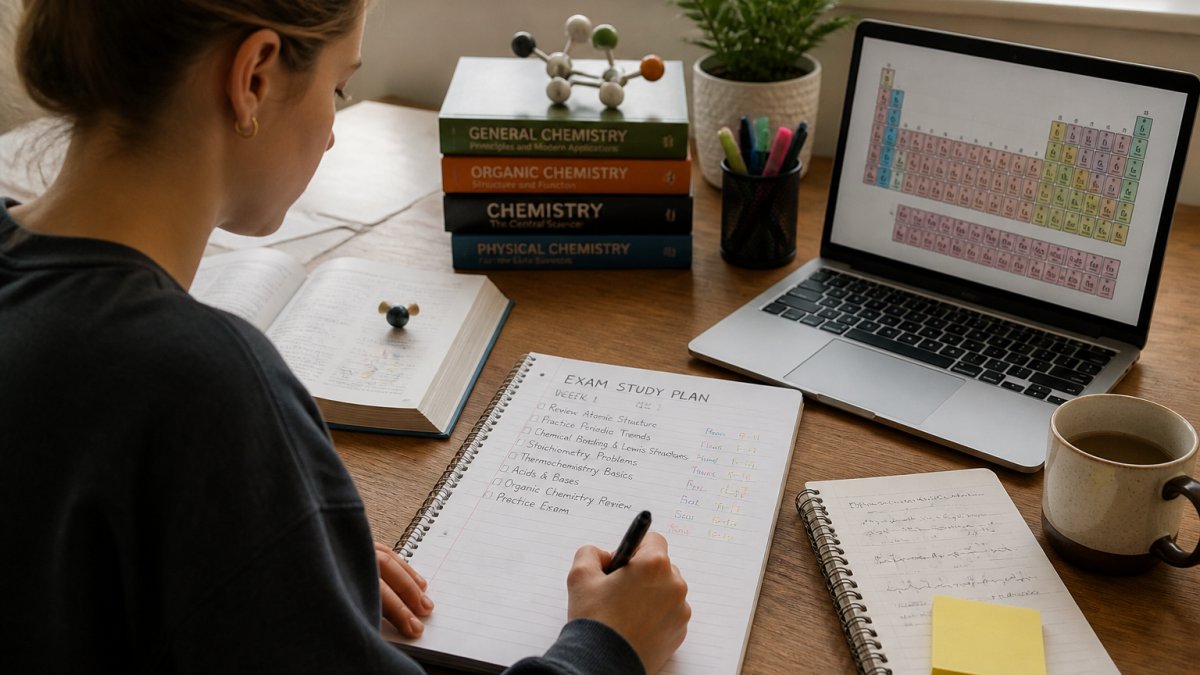
Before any calendar gets built, confirm the prerequisites. Chemistry is not the first rung; it sits on top of algebra, unit conversion, significant figures, and basic graphing.
Here is the structure we use with students, and it fits almost any timeline:
| Phase | Focus | Typical Length |
|---|---|---|
| Diagnose | Identify weak pillars with a practice test | 1-2 sessions |
| Repair | Rebuild weak concepts with worked examples | 40% of total time |
| Apply | Mixed problem sets under time pressure | 40% of total time |
| Simulate | Full timed practice exams | 20% of total time |
A Week-by-Week Path From Foundations to University Readiness
The table above sets proportions; the schedule below turns them into a working calendar. It assumes roughly eight weeks and about six to eight hours of focused work per week, which is a common load for a student preparing alongside a full course schedule. Compress or stretch the phases, but keep the order.
| Week | Focus | What Done Looks Like |
|---|---|---|
| 1 | Diagnostic and prerequisite repair | Topic-scored practice test complete; math gaps listed |
| 2 | Atomic structure, mole concept, stoichiometry | Balance equations and convert units without notes |
| 3 | Reactions, equations, and solution chemistry | Predict products; run molarity and dilution problems |
| 4 | Thermodynamics and thermochemistry | Track enthalpy sign conventions through multi-step problems |
| 5 | Kinetics and equilibrium | Read rate laws; set up ICE tables from scratch |
| 6 | Acids, bases, titrations, and buffers | Choose the right titration curve region before calculating |
| 7 | Intermolecular forces, liquids, gases, and organic basics | Rank boiling points; name simple functional groups |
| 8 | Mixed review and full timed simulations | Two or more full-length exams under real conditions |
Notice the sequencing logic. Stoichiometry precedes equilibrium because equilibrium calculations are stoichiometry in disguise. Acids and bases follow equilibrium because buffers are an equilibrium application. Organic chemistry comes late because it assumes bonding and intermolecular forces are already solid.
Diagnostic Assessment: Finding Your Starting Point
Diagnostic assessment means taking a representative practice test before studying anything, then scoring it by topic rather than by total. A student who scores 70% overall but 30% on equilibrium has a very different plan than one who scores 70% evenly.
Score each pillar separately: stoichiometry, thermodynamics, kinetics, equilibrium, acids and bases, intermolecular forces. The lowest scores become your first study blocks, not your last.
A useful refinement is to tag every missed question with two labels: the topic and the error type. Error types tend to fall into a small set, concept gap, setup error, arithmetic slip, unit conversion, or misread question.
Building University Readiness Beyond a Single Exam
Most exam-prep guides stop at the test date. University chemistry keeps going, and the skills that carry over are not the memorized formulas, they are the habits.
Three habits transfer directly. First, the ability to read a problem, name the concept, and write the setup before calculating. Second, the discipline to track units through every step. Third, the willingness to attempt unfamiliar problems instead of waiting for a worked example. Build these during exam prep and the first month of a university course feels like a continuation rather than a shock.
Chemistry Formulas and Concepts You Cannot Skip
Some formulas appear on nearly every exam, and knowing them cold frees your working memory for actual problem-solving.
The College Board's AP Chemistry course description lists the same core equations as required knowledge, which tells you how consistently they are tested.
What most guides miss is that memorizing a formula is the easy half. The hard half is recognizing which formula a word problem is asking for. Practice that recognition deliberately: cover the question, read only the scenario, and name the concept before solving.
From Word Problem to Setup: A Worked Recognition Drill
Recognition is a skill, and it improves with a specific drill.
Shape 1, a gas at two sets of conditions. A scenario gives an initial volume, pressure, and temperature, then changes two of them and asks for the new volume.
Shape 2, dilution. A scenario gives a stock concentration and volume, then asks for the concentration after adding solvent. Given: M₁, V₁, V₂. Asked: M₂. Concept: dilution. Setup: M₂ = (M₁V₁) / V₂.
Shape 3, equilibrium shift. A scenario gives a balanced equation at equilibrium, then changes concentration, pressure, or temperature and asks which direction the system shifts. Given: the equation and the disturbance. Asked: shift direction.
Unit Tracking: The Cheapest Points You Will Ever Save
Unit errors are the most preventable point losses on a chemistry exam, and they are almost always caused by skipping the unit check. The fix is mechanical: write units next to every number, cancel them like fractions, and confirm the final unit matches what the question asked for.
A quick example. A problem asks for the molarity of a solution made by dissolving a given mass of solute in a given volume of solution. The setup is moles of solute divided by liters of solution. Grams convert to moles using molar mass, and milliliters convert to liters by dividing by 1,000.
The Concept Layer Behind the Formulas
Formulas are shortcuts for concepts, and exams increasingly test the concept directly. The ideal gas law is a statement about how pressure, volume, temperature, and moles relate when collisions with the container walls dominate behavior.
When a problem does not fit a memorized formula, fall back to the concept. Ask what is being conserved, what is changing, and what the question is really measuring. That habit handles unfamiliar problems far better than a longer formula sheet, and it is the same habit that carries into first-year university coursework.
Why Chemistry Practice Problems Beat Re-Reading Notes
Chemistry practice problems beat re-reading notes because chemistry is a performance subject, not a reading subject. You cannot learn to solve unfamiliar questions by looking at familiar ones.
A common mistake is treating highlighting as studying. Students highlight a chapter, feel productive, and then freeze on the exam when nothing looks like their notes. The fix is uncomfortable but simple: close the book and attempt problems from memory, then check your work.
Working Through Problems You Have Never Seen Before
Unfamiliar problems are the entire point of university-level assessment. When you meet one, do not hunt for a memorized solution. Instead: identify what is given, identify what is asked, name the concept that connects them, then write the setup before touching the calculator. Setup errors cost more points than arithmetic errors, and they are far easier to catch when the reasoning is on paper.
Common Mistakes That Derail University Chemistry Preparation
The most damaging mistake is studying topics in isolation. Equilibrium problems secretly test stoichiometry. Titration problems test acids, bases, and mole calculations at once. Students who study each topic in a silo pass the chapter quiz and fail the cumulative exam.
Three more traps we see constantly:
- Memorizing procedures without understanding why each step exists
- Skipping units, then losing points to conversion errors
- Cramming the week before instead of spacing sessions across weeks
A related error is avoiding the topics that feel hardest. That avoidance feels efficient and is actually the opposite.
Exam-Day Strategy: Turning Preparation Into Performance
Exam-day performance is a skill separate from knowledge, and it can be practiced. Students who understand the material but blank on test day usually have a pacing problem, not a memory problem.
Strategy that works: read the entire exam first, answer everything you know immediately, then return to harder problems with the remaining time. Never let one stubborn question consume ten minutes early in the period.
Conclusion: Your Next Step Toward Chemistry Confidence
Chemistry rewards students who repair their foundation before building on it, and that is exactly what personalized instruction is for. At Chemistry Lessons by Annise, we offer expert-led tutoring from a former university professor and organic chemistry research scientist, with more than 30 years of experience and over 1,000 students successfully tutored. Every session is tailored to your specific course, whether that is AP, Honors, Regents, or General Chemistry I and II, online or in person on Long Island. Request a lesson and start turning confusion into confidence.
Frequently Asked Questions
What are the core topics in chemistry I should master first?
Start with atomic structure, the mole concept, and stoichiometry. These three underpin nearly everything else, including chemical reactions, equilibrium, and thermodynamics. Once you can balance equations and convert between grams, moles, and molecules without hesitating, move to acids and bases, then kinetics. Mastering core chemistry topics in this order prevents the gaps that make later chapters feel impossible.
How should I study for a chemistry exam when I am short on time?
Focus on chemistry practice problems rather than re-reading chapters. Work through problems from each major topic, check your answers, and note where you went wrong. Spend the most time on weak areas, not on material you already know. A chemistry exam study plan that allocates even 30 minutes per topic to active problem-solving beats hours of passive review.
Is four days enough to study for a chemistry exam?
Four days can work if you already attended class and did homework throughout the term. Use day one for a diagnostic pass through practice problems to find gaps. Days two and three go to your weakest topics with worked examples. Day four is for a full practice exam under timed conditions. If you are starting from scratch, four days is not enough for university-level material.
How do I identify gaps in my chemistry knowledge?
Take a practice exam or work through a problem set without notes. Every question you cannot start, or get wrong, marks a gap. Group those gaps by topic: stoichiometry, equilibrium, thermodynamics, and so on. Then rank them by how often they appear in your course material. This diagnostic approach tells you exactly where to spend study time instead of reviewing everything equally.
What is the best way to remember chemistry formulas and concepts?
Use them. Formulas stick when you apply them to problems, not when you memorize them from a list. After each practice problem, write down which formula you used and why. Over a week, you will recall formulas because your brain links them to the situations that require them. Flashcards help for constants, but application is what makes chemistry formulas and concepts stay.
How can I prepare for university-level chemistry before the semester starts?
Review prerequisite material: algebra, unit conversions, and basic stoichiometry. Work through a college general chemistry textbook's first two chapters. Practice problems that combine multiple concepts, since university exams rarely test one idea at a time. A structured study plan over the summer, even two hours per week, puts you ahead of students who start cold.