 blog
Alternatives to Memorizing Organic Chemistry Reactions
Table of Contents
- Why Memorizing Organic Chemistry Reactions Fails
- Organic Chemistry Reaction Mechanisms: The Framework That Replaces Rote Recall
- How to Predict Organic Chemistry Products Using Decision Trees
- Build a Reaction Map to See Patterns Across Transformations
- Organic Chemistry Practice Problems: Spaced Retrieval and Interleaving
- Where Organic Chemistry Flashcards Still Belong
- Diagnosing Mistakes and Tracking Mastery
- Conclusion: Reason First, Recall Second
- Frequently Asked Questions
Last Updated: October 21, 2026
Why Memorizing Organic Chemistry Reactions Fails
Organic chemistry rewards pattern recognition, not raw recall. Students who try to brute-force hundreds of reactions into memory hit a wall, because the subject contains far more transformations than any flashcard deck can hold. This guide from Chemistry Lessons by Annise lays out a different path: understanding organic chemistry reaction mechanisms so you can reason toward an answer instead of retrieving one.
The failure mode is predictable. A student memorizes that alkenes add HBr to give the more substituted product, then meets a peroxide and freezes. The fact was stored, but the framework that explains why it happened was never built. When the exam poses a slightly different substrate, the stored answer no longer applies.
The Real Problem: Flashcards Without a Framework
Flashcards work when they encode a rule you already understand. They fail when they substitute for understanding. A deck that says "HBr adds Markovnikov" teaches a label, not a reason. The moment the reagent changes, or the substrate shifts from a simple alkene to something with an existing functional group, the label has nothing to attach to.
The fix is sequencing: build the mechanism first, then let the flashcard confirm it. Students who reverse that order tend to plateau, then panic in the final weeks before an exam.
Organic Chemistry Reaction Mechanisms: The Framework That Replaces Rote Recall
A reaction mechanism is a step-by-step account of how electrons move from one atom to another during a chemical change. That movement explains the product, the conditions required, and the stereochemistry you observe. Once you can draw the electron flow, the product becomes something you derive rather than remember.
Electron Flow, Curved Arrows, and the Four Reaction Types
Curved arrows are the notation for electron flow. The arrow starts at the electron source, usually a bond or a lone pair, and points to where those electrons end up. Read enough mechanisms and a small number of patterns emerge.
Most organic transformations fall into four families:
- Addition: two reactants combine into one product, common with alkenes and alkynes
- Substitution: one group replaces another, as in nucleophilic substitution at an sp3 carbon
- Elimination: a bond forms between adjacent atoms as a small molecule leaves
- Oxidation and reduction: electron count changes, often tracked through functional groups
Classify the reaction first, and you have narrowed the possible products before you draw a single arrow. That classification step is where memorizing organic chemistry stops being necessary and reasoning takes over.
How to Predict Organic Chemistry Products Using Decision Trees
Product prediction becomes manageable when you ask a fixed sequence of questions. The order matters more than any single rule.
Reading Reagents, Conditions, and Regioselectivity
Start with the substrate. Identify every functional group and note which one is most reactive under the given conditions. Then read the reagent as a role, not a name: is it acting as a nucleophile, an electrophile, an acid, or a base? Finally, check the conditions for heat, light, solvent, or peroxide, because those details redirect the pathway.
A workable decision tree looks like this:
- What functional groups are present, and which is most reactive?
- Is the reagent a nucleophile, electrophile, acid, or base?
- Do the conditions favor addition, substitution, or elimination?
- Does regioselectivity follow Markovnikov or anti-Markovnikov addition?
- What stereochemistry does the mechanism require?
Run those five questions on an unfamiliar reaction and you will usually land on the right product family. Compare that with a memorized answer, which only works when the problem matches the example you studied.
Build a Reaction Map to See Patterns Across Transformations
A reaction map is a single page that connects functional groups with arrows showing which reagents convert one into another.
Build it in layers, and label every arrow with three things: the reagent, the mechanism family (addition, substitution, elimination, or oxidation-reduction), and any condition that changes the outcome (heat, light, peroxide, strong base).
A worked example makes the method concrete. Place an alkene at the center.
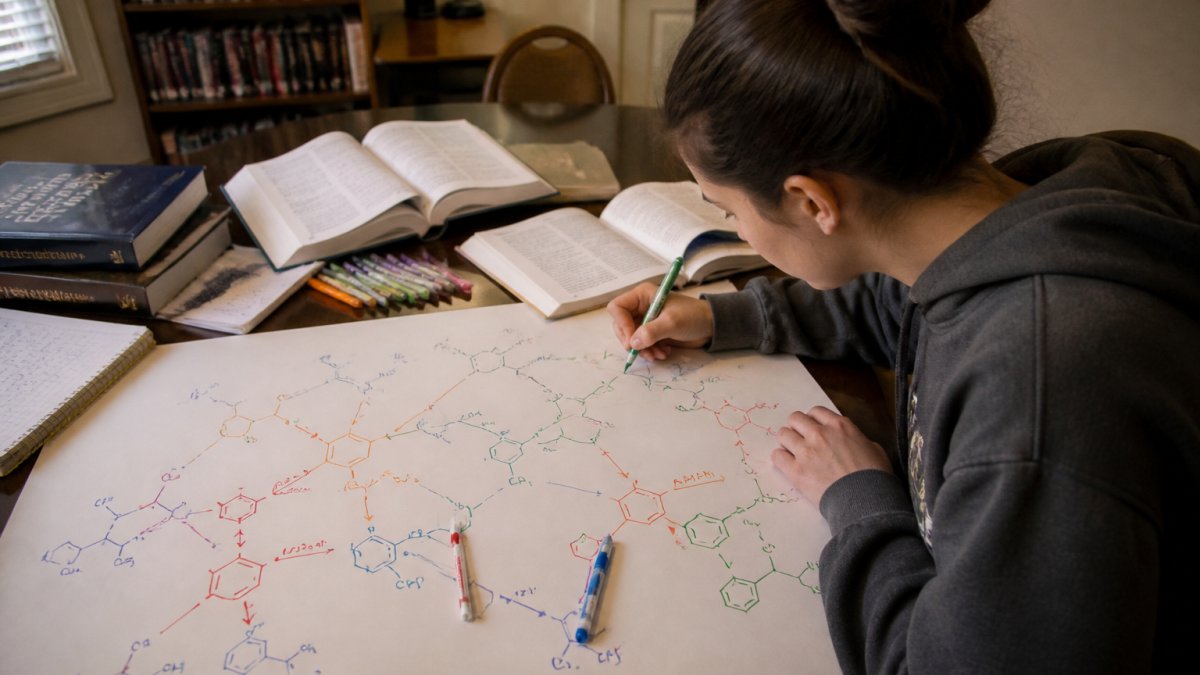
The map also exposes gaps. If you cannot connect two functional groups, that missing arrow is exactly the mechanism you need to review. Students often find that their map has dense clusters around familiar reactions and empty space around the ones they avoid.
Use the map for prediction, not just review. When you meet an unfamiliar reaction, locate the substrate on your map and trace the arrows outward. If the reagent matches one of the labeled arrows, you have a candidate product family.
Organic Chemistry Practice Problems: Spaced Retrieval and Interleaving
Practice only pays off when it is scheduled well. Two techniques do most of the work: spaced retrieval and interleaving.
Spaced retrieval means testing yourself on a topic at increasing intervals, so recall happens after partial forgetting. Interleaving means mixing problem types in one session instead of drilling a single reaction repeatedly. Both feel harder than blocked practice, and both produce stronger retention because they force you to choose a strategy, not just execute one.
A weekly schedule that works:
- Day 1: new mechanisms, worked slowly with the textbook open
- Day 2: retrieval on Day 1 material, closed book
- Day 4: mixed set combining Day 1 material with an older topic
- Day 8: short retrieval quiz, then review only what you missed
- Day 15: interleaved problem set across three or four reaction families
| Practice Method | What It Trains | When to Use It |
|---|---|---|
| Rereading notes | Familiarity, not recall | Avoid as primary method |
| Blocked drilling | Speed on one reaction type | Early introduction only |
| Spaced retrieval | Long-term recall | Throughout the course |
| Interleaved sets | Strategy selection | From mid-semester onward |
| Reaction map review | Pattern recognition | Weekly, before practice |
Adapt the schedule to the course. In an introductory sequence, spend more time on the four reaction families and on distinguishing substitution from elimination; interleaving can start once those families are stable. In an advanced course, interleave earlier and include multi-step synthesis problems, because exams there test sequence planning rather than single transformations. For standardized exams, add timed mixed sets that mirror the section format, and practice choosing a mechanism quickly rather than drawing every arrow in full.
Measure whether the schedule is working. Keep a simple mastery log for each topic with the date, the number of problems attempted, and how many you solved without notes. A topic is stable when you solve it accurately across two spaced sessions; move it to maintenance review and spend the freed time on weaker areas.
Where Organic Chemistry Flashcards Still Belong
Flashcards earn their place for the facts that genuinely require recall. Reagent names, common abbreviations, pKa values, and the vocabulary of functional groups are arbitrary enough that memorization is the efficient choice. Trying to derive the name of a reagent from first principles wastes time you could spend on mechanisms.
The distinction is simple. Memorize the labels. Reason through the transformations. A flashcard asking what DIBAL-H does is useful. A flashcard asking for the product of a reaction you could have predicted from electron flow is a missed opportunity.
Diagnosing Mistakes and Tracking Mastery
Every wrong answer carries information. Sort your errors into three buckets: a missing fact, a misread reagent, or a broken mechanism. Each points to a different fix.
A missing fact means the flashcard deck needs an addition. A misread reagent means you need slower, more deliberate reading of the problem before drawing. A broken mechanism means the framework itself has a gap, and more practice problems will not close it.
Track mastery with a simple log. For each topic, record the date, the number of problems attempted, and how many you solved without notes. Review the log weekly. When a topic shows consistent accuracy across two spaced sessions, move it to maintenance review and spend your time on the weaker areas.
Conclusion: Reason First, Recall Second
The students who succeed in organic chemistry are not the ones with the biggest flashcard decks. They are the ones who can look at an unfamiliar reaction and reason toward the product using electron flow, functional groups, and reaction conditions.
That shift from recall to reasoning takes guided practice, and it is exactly what we build at Chemistry Lessons by Annise. Our instruction comes from a former university chemistry professor and organic chemistry research scientist with more than 30 years of teaching experience, and we tailor each session to your specific course, whether that is AP Chemistry, Honors, Regents, or General Chemistry. Students work through mechanisms with someone who can spot the exact gap in their reasoning and correct it on the spot.
If memorizing organic chemistry has stopped working for you, request a lesson with Chemistry Lessons by Annise and start building the framework that makes the reactions make sense.
Frequently Asked Questions
Does organic chemistry require a lot of memorization?
Some recall is unavoidable: functional groups, pKa values, and common reagents need to be known cold. But memorizing organic chemistry reactions one by one is not the same as learning the subject. Most reactions follow a small set of patterns built on electron flow, nucleophiles, electrophiles, and acids and bases. Once you understand reaction mechanisms, you can reason through unfamiliar transformations instead of searching memory for an exact match. The students who struggle most are usually the ones who tried to memorize a reaction summary list without connecting it to mechanism.
How do reaction mechanisms help you predict organic chemistry products?
A mechanism shows where electrons move and which atoms are electron-rich or electron-poor. When you know how to predict organic chemistry products, you start by identifying the nucleophile and electrophile, then checking the reaction conditions for clues about substitution, elimination, or addition. Curved arrows let you trace a plausible pathway step by step. If your predicted product violates rules like Markovnikov addition or stereochemistry, the mechanism tells you so before you commit to an answer. That reasoning transfers to reactions you have never seen.
What is the best way to practice organic chemistry reactions?
Use organic chemistry practice problems that force prediction rather than recognition. Cover the product, draw the mechanism, then check your work. Mix problem types in one session (interleaved practice) so you practice choosing a pathway, not just executing one. Space sessions across days rather than cramming. Keep a mistake log that records why an answer went wrong: wrong reagent, missed regioselectivity, or a stereochemistry slip. That log becomes your most useful study document because it targets exactly what you have not mastered.
Should I use flashcards to study organic chemistry reactions?
Yes, but narrowly. Organic chemistry flashcards work well for facts that must be instant: reagent names, pKa values, functional group recognition, and named reactions. They work poorly for predicting products, because that skill requires drawing a mechanism, not recalling a card. Use active recall for the factual layer, then move to practice problems for the reasoning layer. If a card only asks you to name a product, rewrite it to ask which mechanism applies and why.