 blog
Is Organic Chemistry Harder Than General Chemistry?
Last Updated: October 28, 2026
Quick Summary
Organic chemistry difficulty is not higher than general chemistry in the way most students assume, because the two courses are demanding in different ways. General chemistry rewards calculation and speed, while organic chemistry rewards spatial reasoning and pattern recognition, so difficulty depends on the student, the instructor, and the kind of thinking each course rewards.
- General chemistry leans on calculation, while organic chemistry centers on structure and mechanism.
- Organic chemistry uses far less arithmetic, shrinking math to a supporting role.
- Students who are strong at math should not assume organic chemistry will be easy.
- Organic chemistry rewards shorter, more frequent practice sessions over long cramming blocks.
- Draw every mechanism by hand rather than copying it from the textbook.
Table of Contents
- Organic Chemistry Difficulty vs. General Chemistry: What Actually Changes
- Is Organic Chemistry Hard? What the Evidence and Students Say
- Organic Chemistry vs. General Chemistry Math: Different Tools, Different Tests
- The Skills Each Course Tests: Conceptual Understanding, Spatial Reasoning, and Problem-Solving
- How to Prepare for Organic Chemistry Before the First Lecture
- Organic Chemistry Study Tips That Match How the Course Is Graded
- Request a Lesson and Build Your Plan for the Semester
- Frequently Asked Questions
Organic Chemistry Difficulty vs. General Chemistry: What Actually Changes
Ask a pre-med student which course worries them more, and most will name organic chemistry before the question ends. That reputation is real, but it is not the whole story.
So is organic chemistry harder than general chemistry? Not in the way most students assume. The two courses are difficult in different ways, and understanding that difference is the single most useful thing you can do before the semester starts.
Below, we break down what actually changes between the two courses, where the difficulty really lives, and how to prepare so the second course does not catch you off guard.
Is Organic Chemistry Hard? What the Evidence and Students Say
Organic chemistry has a reputation problem, and the research on it is thinner than the rumors suggest.
Students themselves do not agree. A Vanderbilt University student account of organic chemistry difficulty described one student finding organic chemistry significantly easier than general chemistry. Others report the opposite. The honest answer is that difficulty depends on the student, the instructor, and the kind of thinking each course rewards.
The course is demanding. It is not uniquely impossible.
Organic Chemistry vs. General Chemistry Math: Different Tools, Different Tests
General chemistry leans on calculation. You balance equations, work stoichiometry problems, solve for equilibrium, and calculate acid-base values. The math is the point, and the exam rewards speed and accuracy with numbers.
Organic chemistry uses far less arithmetic. The math does not disappear, but it shrinks to a supporting role.
Here is how the two courses compare on the dimensions students ask about most:
| Dimension | General Chemistry | Organic Chemistry |
|---|---|---|
| Main tool | Calculation and formulas | Structure and mechanism |
| Core content | Stoichiometry, equilibrium, thermodynamics, kinetics | Bonding, functional groups, reactions |
| Typical exam question | Solve for the unknown value | Predict the product or explain the step |
| Memory load | Moderate, formula-driven | Heavy, but organized by pattern |
| Math intensity | High | Low to moderate |
| Main skill tested | Quantitative problem-solving | Spatial reasoning and pattern recognition |
The practical takeaway: if you are strong at math, do not assume organic chemistry will be easy. If math has always been your weak spot, organic chemistry may actually suit you better than general chemistry did.
Which Quantitative Skills Carry Over
Not all of general chemistry math is left behind. Several habits transfer directly and are worth keeping sharp:
- Dimensional analysis. You still track units when you convert between grams, moles, and molarity in lab contexts.
- Significant figures and precision. Reported measurements and calculated values still follow the same conventions.
- Proportional reasoning. Ratios and scaling appear when you compare reaction rates or concentrations.
- Graph reading. Energy diagrams and rate plots require the same interpretive skills as general chemistry graphs.
What changes is the purpose. In general chemistry, the calculation often is the answer. In organic chemistry, a calculation usually supports a structural conclusion, such as estimating whether a reaction is favorable or comparing the stability of two intermediates.
The New Reasoning That Replaces Calculation
Where general chemistry asks for a number, organic chemistry more often asks for a prediction. That shift shows up in three recurring tasks:
- Product prediction. Given reactants and conditions, determine what forms. This draws on functional group behavior and reaction patterns rather than formulas.
- Mechanism tracing. Follow electrons step by step, showing how bonds break and form. Curved-arrow notation replaces algebraic manipulation as the central tool.
- Selectivity and stability reasoning. Decide which product is favored and why, often by comparing resonance structures, steric effects, and electronic effects.
A Realistic Workload Comparison
Neither course is light, but the work looks different. General chemistry practice tends to be problem sets with many similar calculations, which build speed through repetition. Organic chemistry practice tends to be fewer, longer problems that each require several reasoning steps, so progress can feel slower even when you are working just as hard.
Most students find that organic chemistry rewards shorter, more frequent practice sessions over long cramming blocks, because pattern recognition builds with repetition across days. If you are planning your semester, budget consistent weekly time for drawing and tracing mechanisms rather than saving it all for exam weeks.
The Skills Each Course Tests: Conceptual Understanding, Spatial Reasoning, and Problem-Solving
Each course grades a different skill set, and that is where most study advice goes wrong. General chemistry tests whether you can set up and execute a calculation under time pressure.
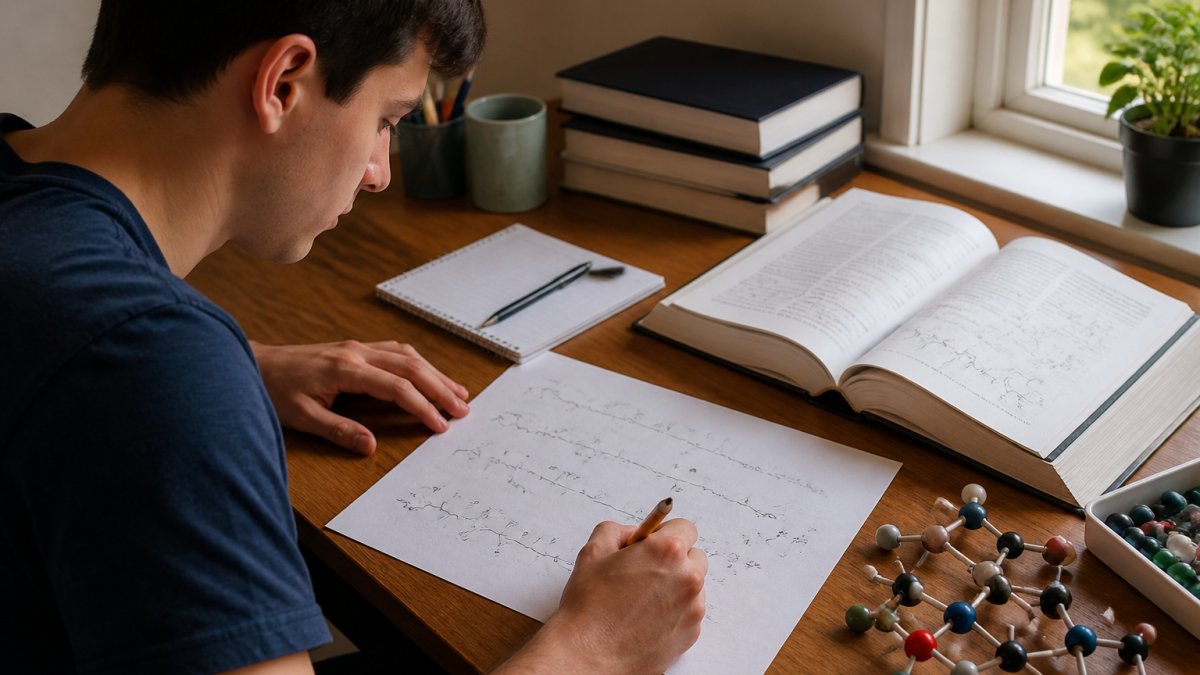
Spatial reasoning matters more in organic chemistry than anywhere else in the sequence.
Logical reasoning carries the rest. Organic chemistry rewards pattern recognition: learn one reaction, then recognize its shape in a new molecule. Memorization alone collapses under the volume.
A common mistake is treating organic chemistry like a vocabulary test. The students who succeed treat it like a logic course with a large case library.
A Self-Assessment Framework: Which Course Fits Your Strengths
Rather than argue about which course is harder in the abstract, use the criteria below to estimate where your own strengths line up. Rate yourself honestly on each row; the pattern matters more than any single answer.
| Skill or habit | General chemistry weight | Organic chemistry weight | What to ask yourself |
|---|---|---|---|
| Algebraic manipulation | High | Low to moderate | Can you rearrange equations and solve for an unknown without hesitating? |
| Unit and dimensional analysis | High | Low | Do you catch unit errors quickly? |
| Spatial rotation | Low | High | Can you picture a tetrahedral carbon and its mirror image? |
| Pattern recognition | Moderate | High | Do you notice when a new problem resembles one you have solved? |
| Multi-step logic | Moderate | High | Can you follow a chain of reasoning without losing the thread? |
| Memorization volume | Moderate | High but structured | Do you retain large sets of facts better when they are grouped? |
| Comfort with ambiguity | Low | Moderate | Can you work a problem where more than one path seems plausible? |
Read the table as a set of trade-offs, not a verdict. A student who scores high on algebra and low on spatial rotation may find general chemistry more comfortable at first, then need deliberate practice with models and drawings to keep pace in organic. A student who dislikes calculation but has strong pattern recognition often finds organic chemistry more intuitive than expected.
Where the Two Courses Overlap
The skills are not entirely separate. Both courses reward careful attention to detail, both require you to show your work, and both test whether you can apply a principle to a problem you have not seen before. The difference is the medium: general chemistry applies principles through numbers, while organic chemistry applies them through structures and electron flow. Students who recognize that continuity tend to adjust faster than those who treat the second course as a completely foreign subject.
How to Prepare for Organic Chemistry Before the First Lecture
Preparation is where you gain the most ground, and it costs less time than people expect. The students who walk in already comfortable with the language of the course spend the first month learning instead of catching up.
Start with your chemistry foundation. If you want to know what online chemistry help for college students is available, that is worth reviewing before the semester begins. Review bonding, electronegativity, acids and bases, and how to read a molecular structure. These are the prerequisite ideas organic chemistry assumes you already own.
- Review Lewis structures and formal charge
- Practice drawing and naming simple molecules
- Refresh acid-base concepts from general chemistry
- Learn the common functional groups before week one
- Build or borrow a molecular model kit and use it
- Skim the first two chapters of your textbook
Organic Chemistry Study Tips That Match How the Course Is Graded
Study habits that earned you a good grade in general chemistry can work against you in organic chemistry. The course rewards practice with mechanisms and patterns, not re-reading notes.
These tips match how the course is actually tested.
- Work practice problems daily, in small batches
- Draw every mechanism by hand, never just read it
- Group reactions by pattern instead of memorizing them one by one, and see alternatives to memorizing organic chemistry reactions for more approaches
- Explain each step out loud to test real understanding
- Use the molecular model kit when a structure confuses you
- Review exam mistakes and redo them a week later
Watch out: copying mechanisms from the textbook feels productive but builds almost no recall. The exam asks you to produce the mechanism, so practice producing it.
Request a Lesson and Build Your Plan for the Semester
The gap between general chemistry and organic chemistry is real, but it is a gap in skills, not a measure of intelligence. Students who understand what changes, and adjust their study habits early, close it faster than they expect.
Annise is a former university chemistry professor and organic chemistry research scientist with more than 30 years of experience, and she has tutored over 1,000 students. Chemistry Lessons by Annise offers personalized instruction tailored to specific course needs, both online and in-person on Long Island.
Get started with Chemistry Lessons by Annise.
Frequently Asked Questions
Is organic chemistry harder than general chemistry 2?
It depends on which skills the course rewards. General Chemistry II leans on calculation: equilibrium, kinetics, thermodynamics, and acid-base problems with numbers. Organic Chemistry II leans on reaction mechanisms, multi-step synthesis, and pattern recognition. Students who are strong at math often find the second general chemistry course more manageable, while students who think visually and logically may find organic chemistry II more intuitive. The organic chemistry difficulty people describe usually comes from the volume of reactions and the need to explain why a mechanism works, not from heavier math.
How much math is in organic chemistry?
Far less than in general chemistry. Organic chemistry uses arithmetic for stoichiometry, yield calculations, and sometimes kinetics, but the core work is drawing structures, predicting products, and explaining reaction mechanisms. You will not spend weeks on equilibrium ICE tables or thermodynamics problems. That said, a weak chemistry foundation in bonding, electronegativity, and acids and bases will slow you down, because those ideas reappear constantly. If math was your struggle in general chemistry, organic chemistry may feel like a relief; if memorization was your struggle, it will not.
Is general chemistry that hard, or does it just have a reputation?
General chemistry is demanding for a different reason than organic chemistry. It moves fast through a wide survey of topics, from stoichiometry and chemical equations to thermodynamics and kinetics, and it assumes comfort with algebra and unit conversion. Many students who call it hard are really describing pace and calculation load rather than conceptual difficulty. The course also varies widely by instructor and grading curve, so two students at different schools can have very different experiences in the same course sequence.
How should I prepare for organic chemistry over the summer?
Review the chemistry foundation the course assumes: chemical bonding, molecular structure, functional groups, acids and bases, and how to read a chemical equation. Practice drawing structures by hand rather than only reading them, because spatial reasoning is a skill you build through repetition. Work a small set of practice problems each week instead of cramming in August, and if you can, preview the first three chapters of Organic Chemistry I.