 blog
AP Chemistry vs Honors Chemistry: Difficulty Levels
Last Updated: October 23, 2026
Quick Summary
AP Chemistry is generally the harder course, but the gap between AP Chemistry vs Honors Chemistry difficulty levels depends far more on your school, your math comfort, and your study habits than on the label on your transcript. Neither course is easy, and the harder one is the one that mismatches your preparation.
- AP Chemistry typically requires 6 to 10 hours of weekly homework, while Honors Chemistry requires 3 to 5.
- AP free-response Section II contains seven questions in 1 hour and 45 minutes: three long and four short.
- Honors usually leaves more room for reteaching before a test, while AP review is expected outside class.
- If several readiness indicators feel shaky, Honors is often the smarter starting point over a rushed AP attempt.
- Ask former students how many hours per week they actually spent outside class to gauge real workload.
Table of Contents
- AP Chemistry vs Honors Chemistry: The Short Answer
- Why Course Labels Don't Tell the Whole Story
- Side-by-Side Comparison: Workload, Pace, Math, Labs, and Assessment
- AP Chemistry Course Content and Curriculum Depth
- AP Chemistry Prerequisites and Readiness Indicators
- AP Chemistry Exam Format and What It Demands
- Building an AP Chemistry Study Schedule That Works
- School-to-School Differences and Course Sequences
- Frequently Asked Questions
AP Chemistry vs Honors Chemistry: The Short Answer
AP Chemistry is generally the harder course, but the gap between AP Chemistry vs Honors Chemistry difficulty levels depends far more on your school, your math comfort, and your study habits than on the label on your transcript. At Chemistry Lessons by Annise, we've watched students succeed in AP and struggle in Honors, and the reverse, often in the same building.
Here's the part most students miss: neither course is "easy," and the harder one is the one that mismatches your preparation. Below, we break down workload, pace, math, labs, and exam demands so you can pick with your eyes open rather than guessing from the course name.
Why Course Labels Don't Tell the Whole Story
A course title describes a curriculum framework, not your daily experience. A College Confidential discussion thread even includes a student who found Honors Chemistry harder than AP at their school, which tracks with what we see in practice.
Schools set their own pace, grading policies, and lab requirements. One Honors section can run at a pace that outworks a neighboring school's AP section. That's why comparing difficulty means comparing the actual course, not the acronym.
Side-by-Side Comparison: Workload, Pace, Math, Labs, and Assessment
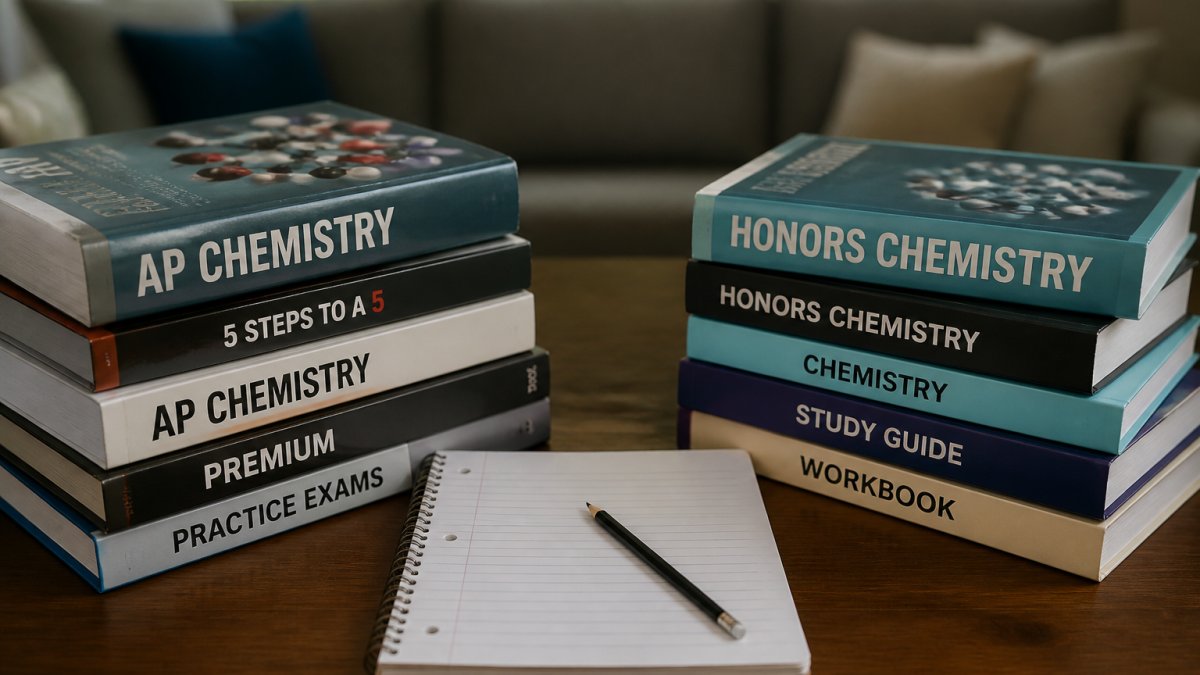
The clearest way to see AP Chemistry vs Honors Chemistry differences is to line up the practical demands. The table below reflects typical patterns across schools, not a universal standard, but it gives you a concrete baseline for comparing your own schedule.
| Factor | Honors Chemistry | AP Chemistry |
|---|---|---|
| Weekly homework | 3-5 hours, mostly practice sets and lab write-ups | 6-10 hours, mixed problem sets, past exam questions, and lab analysis |
| Pace | Steady, with review days before unit tests | Fast, often one new topic per class; review is expected outside class |
| Math demand | Algebra-based calculations (molarity, stoichiometry, gas laws) | Algebra plus multi-step computation, logarithmic and exponential relationships (pH, kinetics, equilibrium) |
| Lab work | Guided labs with clear procedures, 1-2 per month | Inquiry-style labs with independent design, 2-3 per month, plus formal lab reports |
| Assessment style | Unit tests every 3-4 weeks, occasional quizzes | Unit tests every 2-3 weeks, timed AP-style practice, and free-response questions |
| Conceptual load | Foundational concepts with direct application | Deeper reasoning, transfer to unfamiliar contexts, and justification of steps |
The pace difference is where most students feel the squeeze first. AP moves through topics quickly, so a missed week compounds fast. Honors usually leaves more room for reteaching before a test. In practice, an AP student might cover gas laws, kinetics, and equilibrium in the same time an Honors student spends on gas laws alone.
A common pattern is that AP labs demand more writing and analysis. You might spend a full class period collecting data and then another hour or two outside class graphing and interpreting results. Honors labs often stop at the calculation and a few discussion questions.
If you struggled in Honors Chemistry, the table above can help you pinpoint where. A low grade often traces back to stoichiometry or algebraic manipulation, topics that AP assumes you have already mastered. Closing that gap before AP is more effective than jumping in and hoping to catch up.
AP Chemistry Course Content and Curriculum Depth
AP Chemistry course content is built around college-level general chemistry, which is why it carries more depth than Honors. You'll spend real time on equilibrium, thermodynamics, kinetics, electrochemistry, and acid-base systems, plus stoichiometry and atomic structure. The College Board's AP Chemistry course description lays out the full unit structure if you want to see exactly what's covered.
Honors Chemistry touches many of the same topics but typically at a shallower depth, with more emphasis on foundational skills and less on application. The distinction matters: AP asks you to reason through unfamiliar problems, while Honors often asks you to apply a known procedure.
AP Chemistry Prerequisites and Readiness Indicators
AP Chemistry prerequisites usually include a prior chemistry course and solid algebra skills, though exact requirements vary by school. The readiness question is more useful than the prerequisite checklist: can you rearrange an equation, work with scientific notation, and stay calm when a problem has no obvious first step?
Honest readiness indicators we look for:
- You finished first-year chemistry with a grade you understand, not one you scraped by on
- You can solve multi-step algebra problems without a calculator for every step
- You read a lab procedure and can predict what the data should show
- You have a study routine that doesn't depend on the night before a test
If several of these feel shaky, Honors is often the smarter starting point. A strong Honors foundation beats a rushed AP attempt.
AP Chemistry Exam Format and What It Demands
The AP Chemistry exam format is a multiple-choice section plus a free-response section, and the free-response portion is where preparation shows. Per the College Board's 2026 free-response materials, Section II contains seven questions in 1 hour and 45 minutes: three long free-response questions followed by four short ones. That structure rewards speed, clear setup, and the ability to explain reasoning, not just get a number.
Honors assessments usually test unit material with more scaffolding. AP free-response questions often combine topics and expect you to justify each step. Students who understand the concepts but freeze under time pressure tend to struggle here first.
Building an AP Chemistry Study Schedule That Works
An AP Chemistry study schedule should be built backward from your test dates, with weekly problem practice rather than last-minute cramming. A workable pattern many of our students use:
- Two short sessions per week for new material review, 30 to 45 minutes each
- One longer session for timed practice problems, 60 to 90 minutes
- One lab or concept review to connect procedures to the underlying reasoning
- A weekend check to revisit anything that felt shaky
The key is consistency. Short, frequent practice beats a single long session because chemistry rewards retrieval, not rereading.
School-to-School Differences and Course Sequences
Course sequences differ enough between schools that the same label can mean two different experiences. Some schools let students move from Honors directly into AP; others require a full year between them. Some weight Honors and AP differently in GPA calculations, which changes the strategic math for students chasing a weighted GPA.
The only reliable way to compare is to verify the actual course at your school. Here is a practical checklist:
- Request the syllabus for both Honors and AP Chemistry. Look at the unit sequence, not just the topic list. Two courses can cover "equilibrium," but only one may expect you to solve multi-step problems under time pressure.
- Ask about prerequisites and placement policies. Some schools require a teacher recommendation or a minimum grade in Honors before AP. Others allow self-selection. Know which applies to you.
- Check the lab schedule. AP courses typically require more formal lab reports and independent design. If your school's Honors course already includes inquiry labs, the gap may be smaller than the title suggests.
- Talk to former students. Ask how many hours per week they spent outside class and how often they had timed assessments. That gives you a realistic workload estimate.
- Review the GPA weighting policy. If your school weights AP and Honors differently, that affects your class rank and college applications. The course difficulty is only one part of the decision.
If you struggled in Honors Chemistry, that's useful information, not a verdict. It usually points to a specific gap, often in stoichiometry or algebraic manipulation, that can be closed before AP. That's the work we do at Chemistry Lessons by Annise: a former university chemistry professor with more than 30 years of experience diagnosing where a student's foundation cracked and rebuilding it, online or in person on Long Island.
Frequently Asked Questions
Is AP Chemistry harder than Honors Chemistry?
For most students, yes. AP Chemistry moves faster, covers more material, and ends with a college-level exam. That said, the AP Chemistry vs Honors Chemistry gap varies by school. Some Honors sections pile on labs and problem sets that rival AP workload. Ask current students at your school how many hours a week each course demands before you decide.
Should I take Honors Chemistry before AP Chemistry?
Honors Chemistry is the usual path, but it is not strictly required. What matters is whether you have solid algebra skills and comfort with moles, stoichiometry, and lab safety. If your school lets you jump straight to AP, check the AP Chemistry prerequisites on the course syllabus and talk to the teacher. Students who skip Honors often need extra review early in the year, especially on nomenclature and solution calculations.
How much homework does AP Chemistry usually require?
Plan on roughly one to two hours per night, plus longer lab reports some weeks. The College Board designs AP Chemistry as a college-level course, so the reading and problem sets reflect that. Honors Chemistry typically runs closer to 30 to 60 minutes a night. These are general ranges, not guarantees. Track your own schedule for two weeks during the fall and adjust your AP Chemistry study schedule if you are consistently running past 90 minutes.
Can you succeed in AP Chemistry without taking Honors Chemistry first?
Yes, but the first quarter is harder. You will need to pick up lab technique and chemical nomenclature quickly while the class moves into equilibrium and thermodynamics. A realistic AP Chemistry study schedule, weekly tutoring, and a strong algebra foundation close most of that gap. Students who struggled in Honors Chemistry should treat AP Chemistry as a bigger jump and build review time into the first month rather than waiting for the first exam.